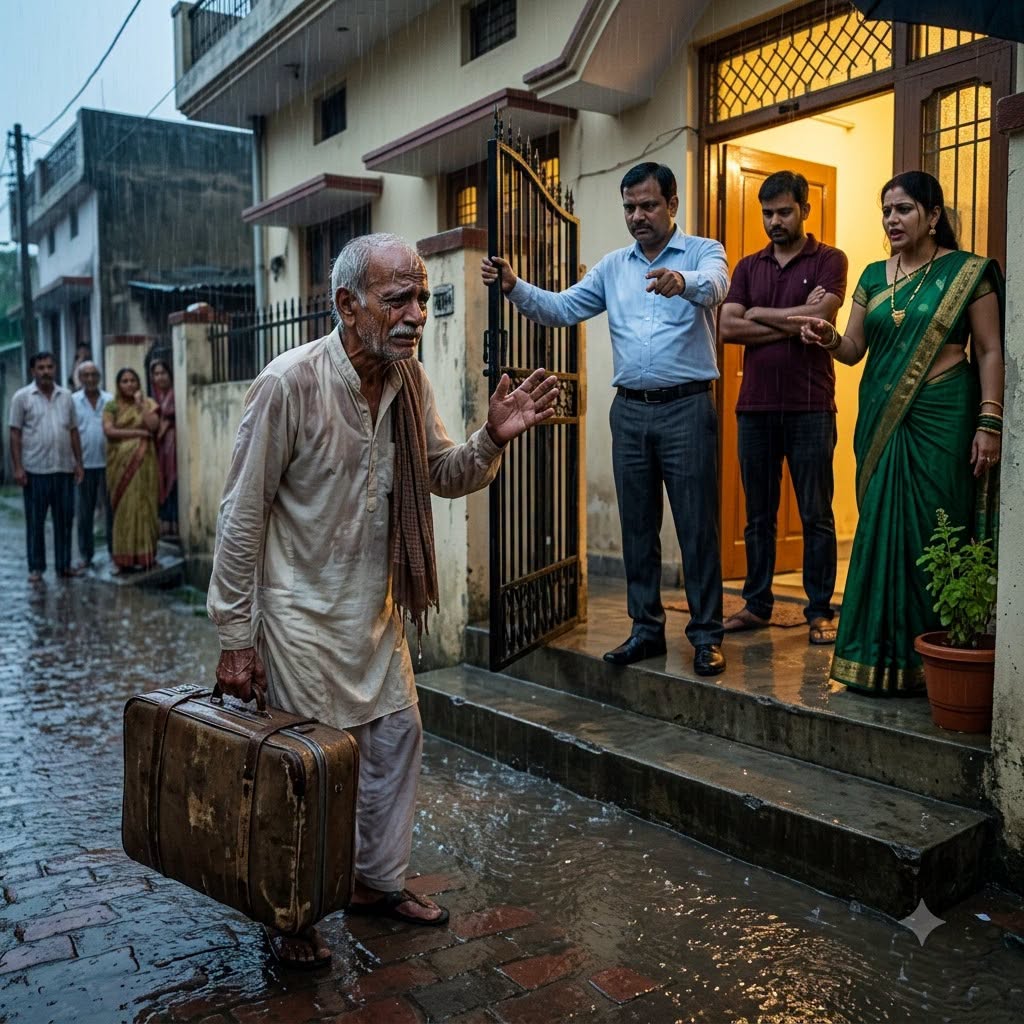
“I said leave.”
He began crying.
“Please forgive us.”
I shook my head.
“Forgiveness is not something you can demand because your plan failed.”
Shashidhar wiped his face.
“What should we do?”
I looked at him.
“Start by telling the truth to your wives. Then cooperate with the lawyer. And stop using my old age as an excuse for your greed.”
They sat silently.
Then Avinash whispered, “Will you ever come home?”
I looked toward the street.
“I don’t know.”
The legal process took months.
The records were examined.
The old registration history was traced.
The documents my sons had persuaded me to sign were reviewed.
The lawyer helped me seek protection and challenge the circumstances in which I had been removed from my home.
Triveni cooperated fully.
She produced old receipts, correspondence, and the declaration she had signed with Kaveri.
The ownership questions were complicated, and the old arrangement required careful legal resolution.
But one thing became clear.
My sons had not acquired the unquestionable ownership they had claimed.
Their attempt to use the property as security could not proceed as they had planned.
And their treatment of me became part of a formal complaint.
During those months, I stayed with Madhav and Triveni.
They never made me feel like a burden.
Every morning, Triveni brought me tea.
Madhav read the newspaper with me.
Sometimes we argued about cricket.
Sometimes we sat quietly.
And sometimes I cried when nobody was looking.
One evening, Triveni found me holding Kaveri’s broken bangles.
She sat beside me.
“Missing her?”
I nodded.
“She warned me.”
Triveni looked down.
“She loved you.”
I smiled through tears.
“She sold her gold to help me build that house.”
Triveni nodded.
“And even at the end, she was trying to protect it.”
I looked at the bangles.
For years, I had believed my greatest achievement was building a home for my children.
Now I understood that Kaveri’s greatest gift had been trying to protect the man who built it.
Six months later, the immediate dispute over my right to remain in the house was resolved through legal proceedings and a written arrangement.
The broader title issues required further documentation, but my sons could no longer simply treat me as someone with no rights.
I was offered the opportunity to return.
I stood outside the gate for a long time.
The courtyard looked different.
The walls had been repainted.
The tulsi plant was gone.
And Kaveri’s handprint had disappeared beneath white paint.
Avinash stood near the entrance.
Shashidhar was beside him.
Both looked ashamed.
“Bauji,” Avinash whispered, “please come inside.”
I looked at the house.
The roof I had built.
The walls I had plastered.
The windows I had installed.
Then I looked at my sons.
“I will come inside today.”
Their faces brightened.
“But I am not moving back permanently.”
Avinash’s smile vanished.
“Why?”
I took a slow breath.
« Parce que je ne me sens plus en sécurité en dépendant de votre bienveillance. »
J’ai traversé les pièces.
L’ancienne cuisine.
L’escalier.
La cour.
Chaque recoin renfermait un souvenir.
J’ai touché le mur où se trouvait autrefois l’empreinte de la main de Kaveri.
J’ai alors demandé un petit marteau et un burin.
Avinash semblait perplexe.
« Bauji, que fais-tu ? »
Je me suis agenouillé avec précaution.
Puis il a commencé à enlever la fine couche de peinture.
Cela a pris du temps.
Mes mains n’étaient plus aussi fortes qu’avant.
Mais je savais travailler le plâtre.
Lentement, sous la couche blanche, apparut la faible silhouette d’une paume.
L’empreinte de la main de Kaveri.
Je me suis arrêté.
Mes yeux se sont remplis.
« Te voilà », ai-je murmuré.
Pour la première fois depuis des mois, je me suis sentie proche d’elle.
Je ne suis pas retournée vivre avec mes fils.
Au lieu de cela, j’ai emménagé dans une petite maison louée près de Madhav et Triveni.
Il y avait une chambre.
Une véranda étroite.
Et suffisamment d’espace pour un plant de tulsi.
J’ai commencé à enseigner les techniques de base de la maçonnerie à de jeunes travailleurs du quartier.
Certains avaient quitté l’école prématurément.
Certains avaient besoin d’un emploi.
Certains voulaient simplement apprendre un métier.
Je leur ai appris à mesurer les murs.
Mélanger le mortier.
Poser des briques.
Et comprendre pourquoi des bases solides étaient importantes.
Un après-midi, un jeune garçon m’a demandé : « Dadaji, pourquoi travaillez-vous encore à votre âge ? »
J’ai souri.
« Parce que ces mains n’ont pas oublié comment construire. »
Mes fils venaient me rendre visite de temps en temps.
Au début, les conversations étaient gênantes.
Ils ont apporté des bonbons.
On m’a posé des questions sur mes médicaments.
On m’a proposé de l’argent.
J’ai accepté ce dont j’avais besoin et refusé ce qui s’accompagnait d’attentes.





