I thought of the document supposedly signed on the day Ma died.
I remembered sitting beside her hospital bed until sunrise.
Shashidhar had come for twenty minutes.
He said he had a meeting.
Apparently he had been busy creating evidence of a consent I had never given.
I wiped my tears.
“What happens if the signatures are forged?”
The bank officer answered carefully.
“The matter will be referred for investigation. Any lending decisions will depend on verified security and the actual agreements.”
I nodded.
Then I asked the question that frightened me most.
“Does my son know?”
Nobody answered.
And somehow, that silence was worse.
I called Pradyumna.
He answered immediately.
“Amma?”
“Come to Nandkumar Uncle’s office.”
“Papa said you’re trying to destroy the company.”
“Come alone.”
A pause.
Then he whispered, “I’m already outside.”
I turned toward the window.
My son was standing near the entrance.
He had been waiting.
When he entered, he looked as though he had not slept.
“Amma, I’m sorry.”
I stared at him.
“For what?”
His eyes filled.
“I knew about the warehouse.”
My chest tightened.
“How long?”
“Six months.”
“Did you know about the signatures?”
He shook his head quickly.
“No. I swear.”
“Then what did you know?”
He sat down.
“Papa told me the property would eventually belong to the family, and that you had agreed to help secure the loan.”
I closed my eyes.
“Did you believe him?”
“At first.”
“And afterward?”
Pradyumna looked at the floor.
“I saw an email from the lawyer asking for independent confirmation of your consent. Papa told me not to reply.”
I felt something break.
“You said nothing.”
He began crying.
“I was afraid.”
“Of your father?”
“Of losing everything.”
I looked at my son.
The boy I had raised.
The boy whose school fees I paid from my savings when Rathore Textiles struggled.
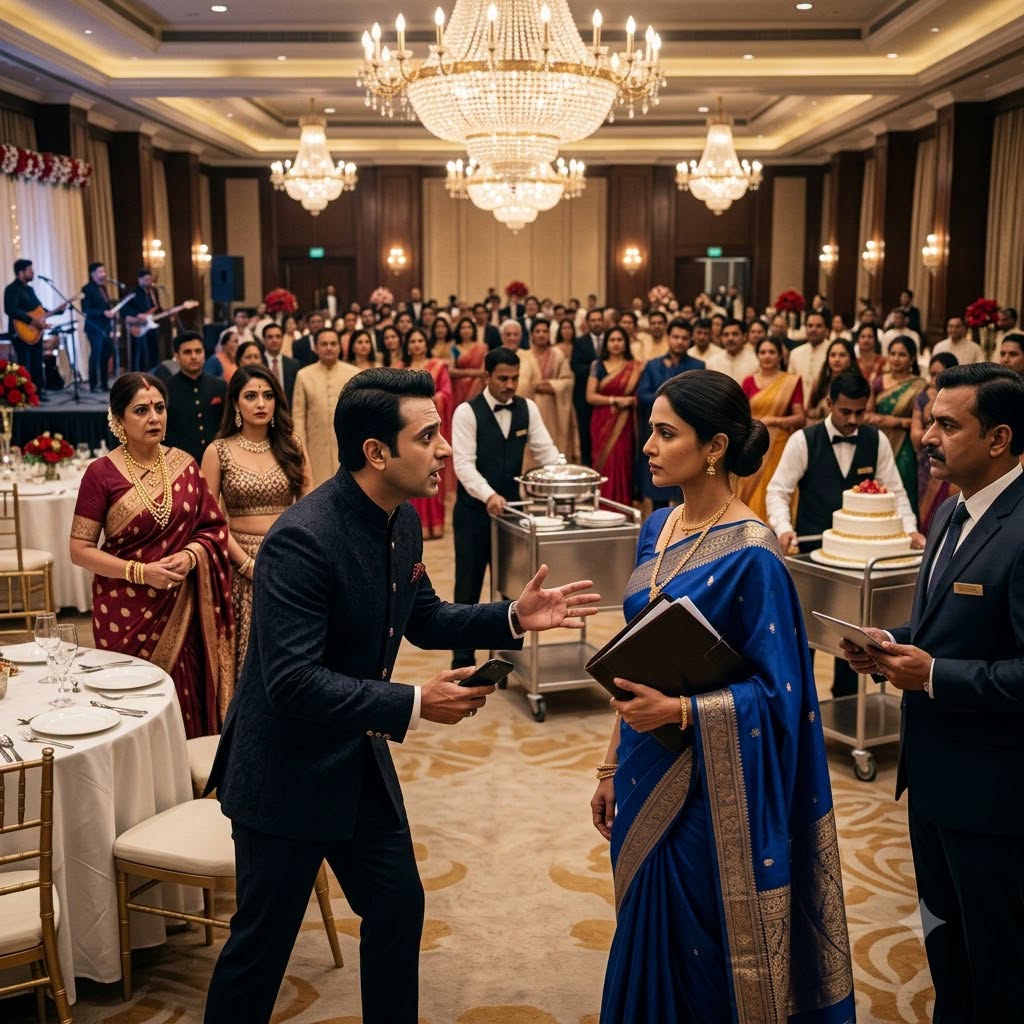
The boy who watched his father humiliate me before four hundred guests.
And remained silent.
I wanted to hold him.
I also wanted to ask how he could have become so much like the man who frightened him.
Instead, I said, “You will tell the truth now.”
He nodded.
“Even if it costs the company?”
“Yes.”
He wiped his face.
“Then I will.”
That afternoon, we met Advocate Ishwari Menon.
She reviewed the deeds, the bank correspondence, the old settlement and my father’s letter.
She did not promise miracles.
She did not tell me I would automatically inherit everything.
She explained which interests were registered, which documents required verification, and which claims might have to be decided by a court.
Then she asked me something no one had asked in years.
“What do you want, Vaidehi ji?”
I sat silently.
For twenty-eight years, every decision had been about what the Rathores needed.
Their business.
Their reputation.
Their creditors.
Their celebrations.
Their pride.
I had forgotten how to answer a question about myself.
Finally, I said, “I want my property protected.”
She nodded.
“And?”
“I want every rupee I contributed to be accounted for.”
“And?”
I looked toward the window.
“I want to stop being afraid of going home.”
Ishwari closed her notebook.
“Then we start there.”
That evening, I did not return to the Rathore house.
I went to my daughter Ishwari’s apartment in Pune.
When she opened the door and saw my suitcase, she began crying.
“Amma.”
I tried to smile.
“I hope you have room.”
She pulled me into her arms.
“For you? Always.”
I slept for eleven hours.
The next morning, I woke to the smell of ginger tea.
No one shouted for breakfast.
No one complained that the rotis were cold.
No one asked why I was sitting instead of working.
Ishwari placed a cup beside me.
“Amma, you can stay as long as you want.”
I looked at her.
For the first time in years, I believed someone meant it.
Two days later, Shashidhar called.
I answered.
“Come home,” he ordered.
“No.”
A silence followed.
“What did you say?”
“I said no.”
“Vaidehi, enough drama. The bank is threatening our credit facilities.”
“Then speak to the bank.”
“You need to sign the revised documents.”
“No.”
His breathing changed.
“You’re destroying thirty years of work.”
I looked at my father’s letter on the table.
“Whose work, Shashidhar?”
He did not answer.
I continued.
“Yours? Mine? Your father’s? Mrinalini’s?”
The silence became absolute.
Then he whispered, “Who told you about her?”
I closed my eyes.
So it was true.
He had spent twenty-eight years making me believe a woman was dead before she ever had the chance to leave him.
“Did you marry me because of Papa’s warehouse interest?”
He said nothing.
“Answer me.”
Finally, he whispered, “Ma thought the marriage would bring the families together.”
“Financially?”
“Vaidehi—”
“Was I ever anything more than a signature you hoped to obtain?”





