Fresh curtains.
And family photographs on the wall.
One showed Gaurika with her mother.
Another showed Nandkumar smiling beside his granddaughter.
The third was an old photograph.
Bhaskar and Nandkumar standing together outside a college building.
I stopped before it.
My husband looked so young.
So alive.
For a moment, I could almost hear his laughter.
Nandkumar came beside me.
“He was a good man,” he said softly.
I nodded.
“Yes.”
Then he whispered, “He loved you very much.”
Tears filled my eyes.
“I know.”
Nandkumar smiled sadly.
“He told me once that you were the bravest person he knew.”
I laughed through tears.
“Your friend had a habit of exaggerating.”
The old man shook his head.
“No. I think he was right.”
That night, after dinner, Gaurika came to my apartment.
She carried her cloth doll.
“Aunty?”
“Yes, sweetheart?”
“Can I sleep here tonight?”
I smiled.
“Of course.”
She sat beside me.
Then looked at the photograph of Bhaskar above my bookshelf.
“Is that your husband?”
I nodded.
“Yes.”
She studied his face.
“Dadu says he helped Mummy.”
My throat tightened.
“He tried to.”
She looked at me.
“Do you miss him?”
“Every day.”
She considered that.
Then she placed her small hand over mine.
“Maybe he knew you’d help us.”
I began crying.
Because that was exactly what his letter had said.
He had trusted that when someone frightened came knocking, I would open my door.
And I almost hadn’t.
A year after that terrible night, our housing society organized a small gathering to thank the residents who had helped arrange an emergency response plan for elderly people living alone.
There were new procedures for checking on residents who requested assistance.
A volunteer group helped with groceries and medical appointments.
Emergency contact details were updated with consent.
And nobody was expected to rely on banging against a wall when they fell.
At the gathering, the society secretary invited me to speak.
I stood before the neighbors.
Some of them had complained about the noise from Flat 403 just as I had.
I looked around the room.
Then said quietly, “For six months, I believed my neighbor was inconsiderate.”
The room became silent.
“I heard banging, crying, and furniture moving. I assumed he didn’t care that other people needed sleep.”
I swallowed.
“But on the night I finally knocked on his door, I discovered an elderly man who had fallen while trying to reach his phone.”
Tears filled my eyes.
“And a child who had been frightened to ask for help.”
I paused.
Then continued.
“Please don’t misunderstand me. Noise complaints matter. We all deserve peaceful homes.”
I looked toward Nandkumar.
He was sitting beside Gaurika.
“But sometimes the sound that irritates us is someone else’s attempt to survive.”
The room remained quiet.
Then I said something I wished I had understood much earlier.
“Before deciding that someone is disturbing your peace, make sure they aren’t asking you to help them find theirs.”
Nandkumar began crying.
Gaurika stood and clapped.
Then everyone else joined her.
I looked at the little girl.
And smiled.
Afterward, she came running toward me.
“Aunty!”
I bent down.
“Yes?”
“Dadu says you’re our hero.”
I laughed.
“Oh, sweetheart. I’m only the neighbour who finally opened the door.”
She shook her head.
“No.”
Then she hugged me.
“You’re the neighbour who stayed.”
My throat closed.
I held her tightly.
That evening, I returned to my apartment.
The hallway was quiet.
The wall beside my bedroom no longer shook at night.
There were no frightening crashes.
No desperate knocks.
But sometimes, just before sleeping, I still remembered that rainy Tuesday morning.
Three seventeen.
My bare feet against the cold tiles.
My fist striking the wooden door.
My phone ready to call the police.
I remembered how angry I had been.
How certain.
How wrong.
Then I remembered Nandkumar’s trembling voice.
Sorry, beti.
Even while injured, he had apologized for disturbing me.
That memory stayed with me more than anything else.
Because I finally understood that the saddest part of growing old is not always weakness.
Sometimes it is the fear that needing help makes you a burden.
A few weeks later, I found Gaurika standing outside my door holding a small drawing.
She smiled.
“I made this for you.”
I took it.
It showed two apartment doors facing each other.
One was labelled 403.
The other 404.
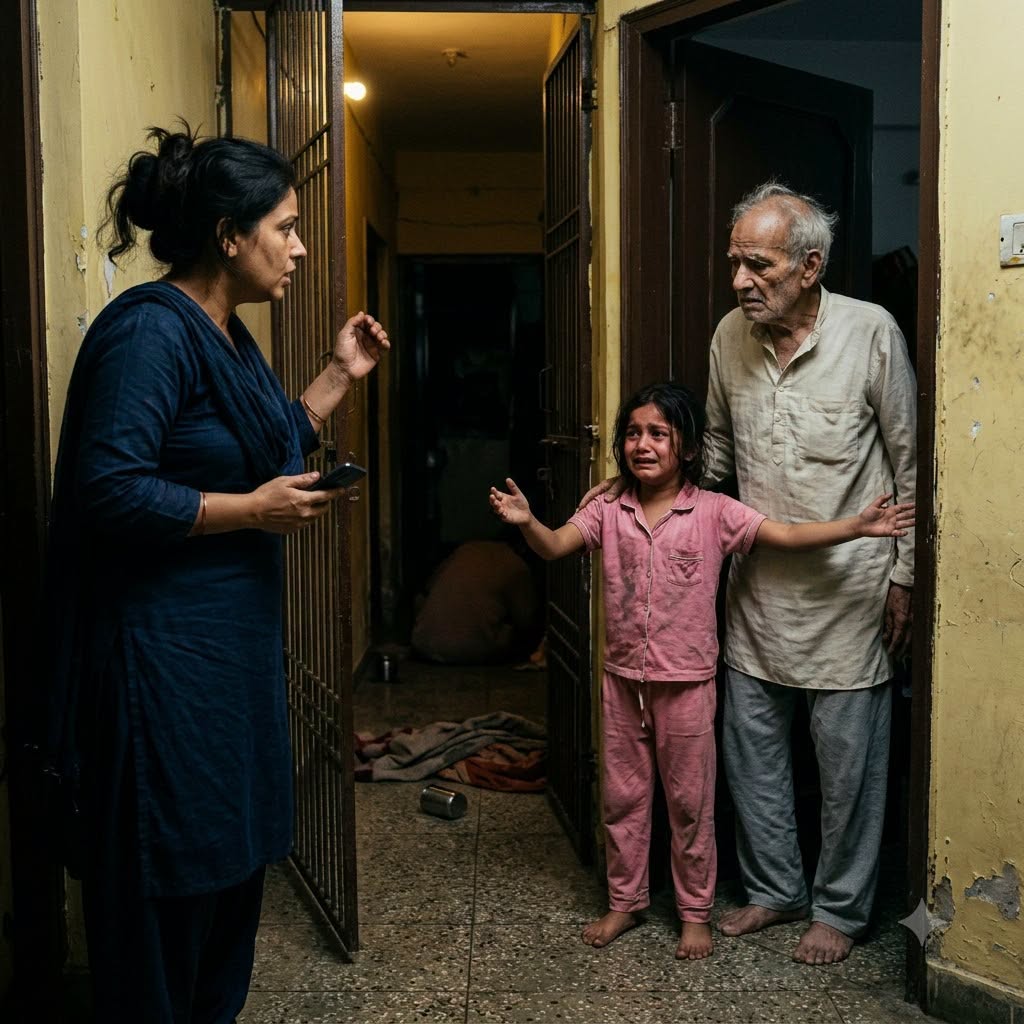
Between them stood a little girl holding hands with an elderly man and a woman in a blue saree.
Above them, in uneven handwriting, were five words.
SOME DOORS LEAD TO FAMILY.
I stared at the drawing.
Then looked at Gaurika.
“Is that what you think we are?”
She nodded.
“Dadu says family isn’t only people who share your surname.”
I smiled through tears.
“What else is it?”





