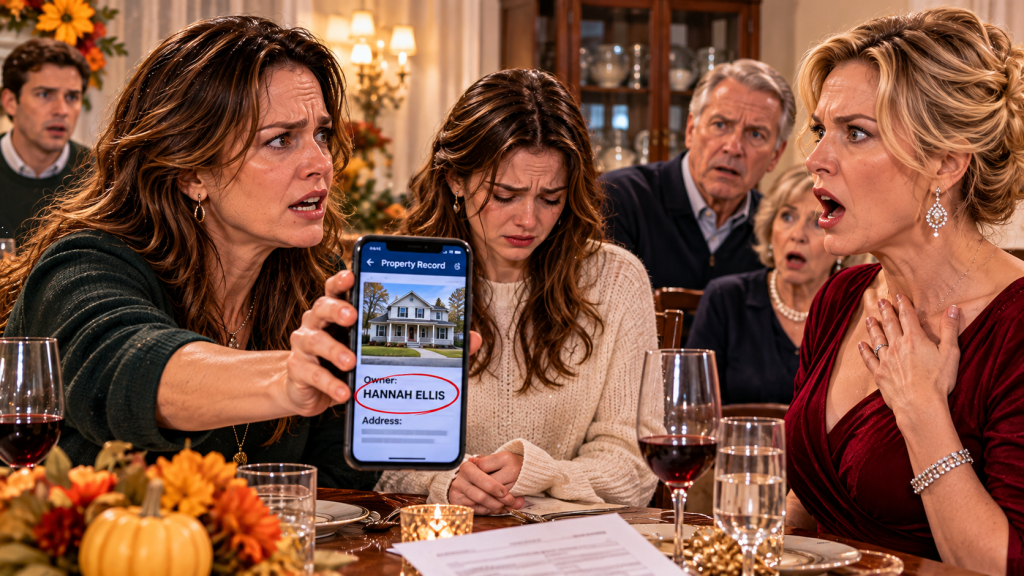
“Your daughter will never own a house,” my sister Brooke announced over Thanksgiving dinner. “Not on what she earns.”
She lifted her wineglass toward Hannah as if she’d made a charming joke. My twenty-six-year-old daughter lowered her eyes and folded her napkin once, then again, hiding the tiny shake in her fingers.
“Brooke,” I said.
“What? I sell houses, Rachel. I know what buyers look like.”
Hannah had spent the morning helping me cook. She’d arrived straight from a twelve-hour nursing shift, still wearing the sneakers whose soles she kept gluing back together. I’d offered to buy her new ones last month. She’d smiled and said, “After closing, Mom.” I thought about that as Brooke inspected the little diamond on her own wrist.
For four years, Hannah had rented Brooke’s basement apartment in Columbus. It wasn’t charity. She paid $1,100 every month, shoveled snow, and climbed the stairs to help when Brooke’s husband hurt his back. Brooke loved telling people she’d “taken the girl in.”
“I guess not everyone is meant to own property,” Brooke added.
Hannah reached for her water. She missed the glass by an inch.
I took out my phone and opened the Franklin County property record. The deed had been recorded Tuesday, two days after Hannah and I carried the last boxes out of that basement.
“Who’s this?” I asked, turning the screen.
Brooke leaned forward. The house in the photograph was small, white, and needed a new porch railing. Beneath the address was a name.
HANNAH ELLIS.
The laughter died. My father set down his fork.
“She bought it?” he asked.
“She saved for six years,” I said. “The bank approved her mortgage. She closed Monday.”
Brooke’s face changed, but it wasn’t admiration. She looked at Hannah, then at me, as if we’d broken a rule she hadn’t explained.
“You couldn’t afford a down payment,” she said sharply.
Hannah stared at her plate. “I found a way.”
I knew why those words stung. Four years earlier, Brooke had persuaded Hannah to sign a rental agreement promising that $250 of each monthly payment would be returned toward a first-home purchase if she stayed three years. Hannah had stayed four. The promised money had never come.
I set a folded copy of that agreement beside Brooke’s untouched dessert plate.
“Since you’re an expert on homeownership,” I said, “maybe you can tell us where my daughter’s twelve thousand dollars went.”
Brooke put down her glass so hard the stem cracked.
Brooke grabbed the agreement and held it close to her chest.
“That was never a savings account,” she said. “It was an incentive. She left before we finalized anything.”
“After forty-eight months,” Hannah replied, her voice barely audible. “I gave you thirty days’ notice.”
Brooke turned toward our parents. “Are you really letting them accuse me of stealing at Thanksgiving?”
My mother, who rarely interrupted Brooke, asked one question. “Did you promise the money or not?”
Brooke didn’t answer.
We left before pie. In the car, Hannah held the shoes she’d changed out of at the door. She rubbed at a streak of hospital disinfectant on one toe.
“I didn’t want them to know,” she said. “About the agreement.”
“Why?”
“Because I thought I was stupid for believing her.”
I remembered Hannah at twenty-two, sitting at my kitchen table with that agreement, excited that her aunt had found a way to help her build a future. After her dad died, she’d been careful about every dollar. She’d picked up holiday shifts and saved birthday cash in a jar marked FRONT DOOR.
“You weren’t stupid,” I said. “You trusted someone who signed her name.”
By Saturday, Brooke had moved from insults to threats. She sent a message to our family group claiming Hannah had damaged the apartment and owed thousands in repairs. Attached was a photograph of the basement floor after a pipe had burst two winters earlier.
Hannah showed me the repair receipts. Brooke’s insurer had paid for the plumbing work, and Hannah had helped carry soaked boxes upstairs that night. In one photograph, taken by Brooke herself, Hannah stood knee-deep in water holding an armful of family albums.
Then Brooke called Hannah’s new lender.
We learned because the loan officer forwarded Hannah a message Brooke had sent to the bank’s public contact address, alleging Hannah had concealed unpaid rent. The purchase had already closed, so Brooke couldn’t cancel it. Still, Hannah sat at her new kitchen table with her hands flat on the wood, reading the allegation over and over.
“What if they believe her?” she whispered.
I helped her send the signed agreement, bank records, notice to vacate, and photographs of the clean apartment. Her loan officer confirmed that the message had no effect on the completed mortgage, but advised her to keep the records.





