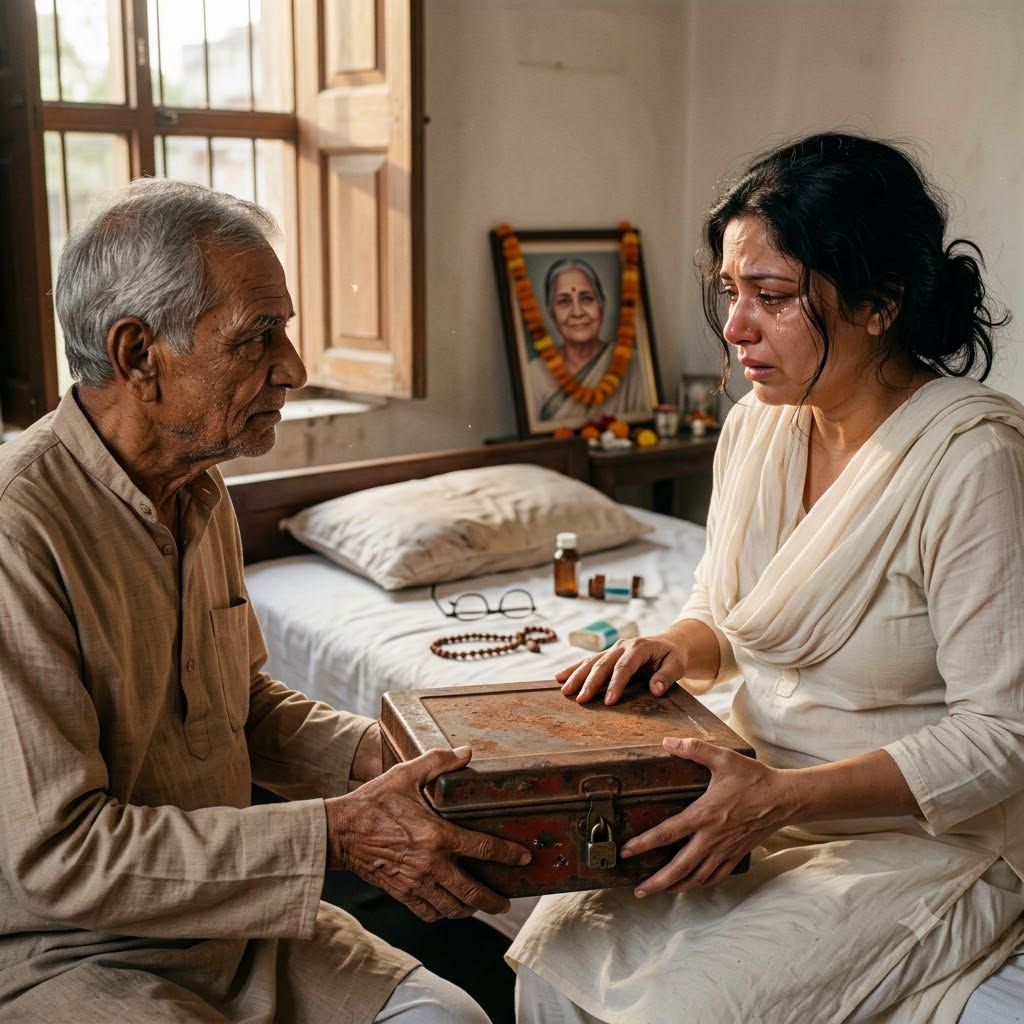
“I know you will blame yourself.”
Her voice trembled.
“You always did, even when you were small.”
I began crying.
“When you broke a glass, you thought you had ruined the whole kitchen.”
A faint laugh.
“When you failed an examination, you thought you had ruined your future.”
I smiled through tears.
“And when that terrible night happened, you thought you had ruined every life in our family.”
There was a long pause.
Then she whispered:
“You made a terrible mistake, Madhav. I made one too.”
My chest tightened.
“I should not have lied to protect you.”
I began sobbing.
“I thought I was saving my child. But I was also teaching him that truth was something to fear.”
Her voice weakened.
“I am sorry for that.”
I pressed the recorder against my heart.
Then came her final words.
“Please don’t spend the rest of your life punishing yourself for what neither of us can change.”
A pause.
“Love your family.”
“Tell the truth.”
“And when someone you love asks you to come, don’t always say tomorrow.”
The recording ended.
Nobody spoke.
I stood there holding the little machine.
For thirty-two years, my mother had carried the blame for an accident I caused.
For even longer, she had carried the secret of a son she could not openly claim.
She had protected us with love.
And sometimes with fear.
She had made choices that saved us from pain.
And choices that created new pain.
But she had never stopped loving us.
Not once.
That evening, after everyone left, I sat alone in Amma’s old bedroom.
Her prayer book lay beside the bed.
The rusted steel box rested on the table.
I opened it one final time.
Inside were the letters.
The photographs.
The bank statements.
And a small folded note I had somehow missed.
On it, in Amma’s handwriting, were just two sentences.
My Madhav, you spent your childhood believing I could read your face.
The truth is that I never needed to read your face to know when you needed love.
I held the paper against my heart.
Then whispered into the quiet room:
“Amma, I finally understand.”
There was no answer.
But for the first time since her death, the silence did not feel empty.
It felt like the space she had left for me to become a better man.
I could not return to the days when she waited for my calls.
I could not give her another Diwali.
Another birthday.
Another ordinary Sunday afternoon.
But I could honor her by refusing to waste the time I still had with the people who loved me.
I picked up my phone.
Called Pradyumna.
Then Vaidehi.
Then my son.
Not because there was an emergency.
Not because someone needed money.
Simply because I wanted to hear their voices.
And as the evening settled over Nashik, I finally understood the greatest tragedy of losing a mother.
It is not only that she is gone.
It is that you suddenly remember all the ordinary moments when she was still there—and you believed you had forever.
If you were Madhav, could you ever forgive yourself after discovering that your mother carried the blame for your mistake for thirty-two years? And do you believe Sulochana was right to hide her firstborn son to protect the family, even though the truth caused so much pain? Share your feelings in the comments, and follow the page for more unforgettable stories about mothers, sacrifice, hidden family secrets, and the love we sometimes understand only after it is too late.





