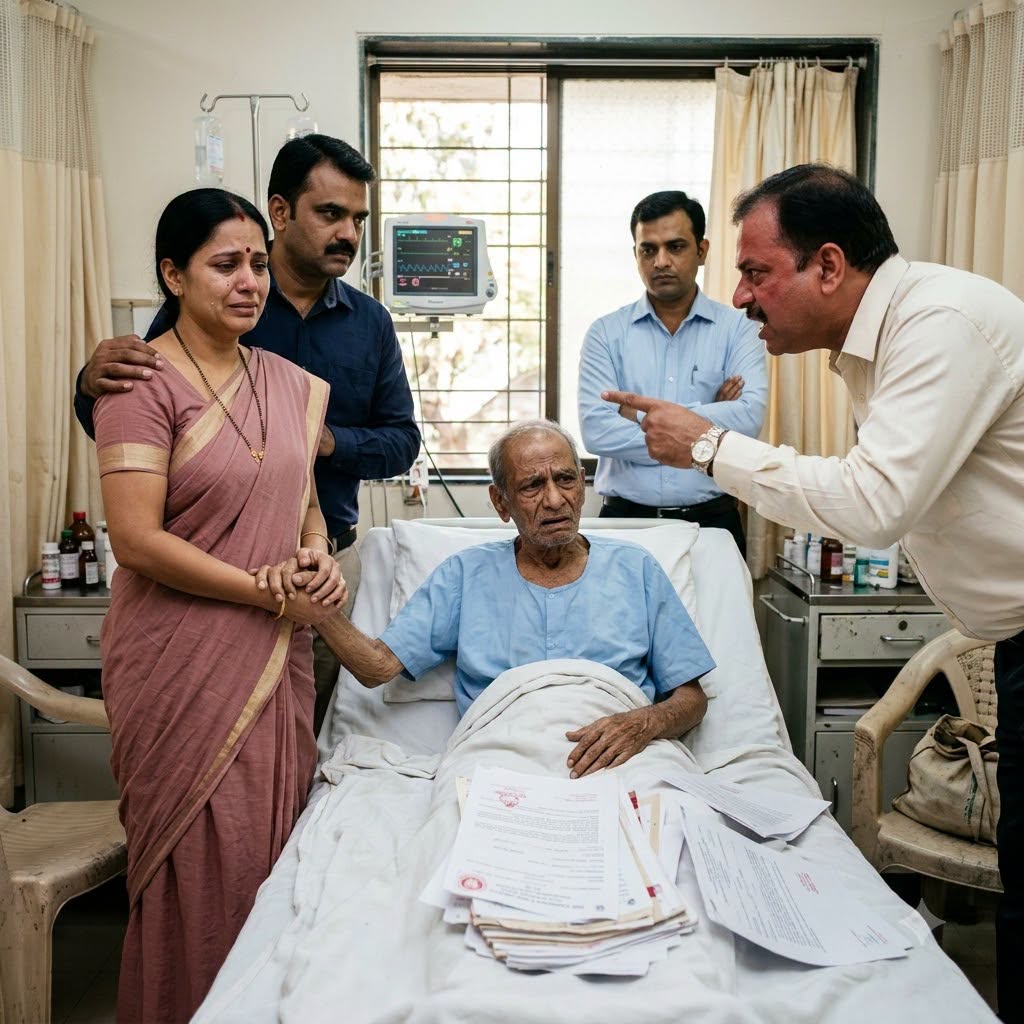
I nodded.
“What can I do?”
“We need to verify the registered records and identify who signed each document. Your father cannot simply decide the house belongs to you as compensation if there are other legal interests involved.”
I looked down.
“I don’t want to throw my parents out.”
“That isn’t necessary to begin addressing the wrong.”
She paused.
“But you should not surrender your rights simply because the people involved are family.”
Those words stayed with me.
Two days later, Pradyumna called.
“Didi?”
“Yes?”
His voice sounded ashamed.
“I’ve been thinking about what happened.”
I remained silent.
“I should have helped with Papa’s hospital bills.”
I closed my eyes.
“Yes.”
He swallowed.
“I kept telling myself I’d send money after my EMI. Then another expense came up.”
I looked toward the window.
“Pradyumna, I didn’t need you to pay everything.”
“I know.”
“I needed you to care enough to do something.”
His voice broke.
“I’m sorry.”
For a long moment, neither of us spoke.
Then he said, “I’m transferring my share of the medical expenses today. And I’ll contribute monthly toward Papa’s rehabilitation.”
I nodded.
“Thank you.”
He hesitated.
“Didi, I didn’t know about your land.”
“I believe you.”
His voice trembled.
“But I should have defended you when Raghavendra bhaiya spoke like that.”
I wiped my eyes.
“Yes. You should have.”
Raghavendra was different.
He sent angry messages.
He accused me of turning Papa against him.
He said I was using an old mistake to take control of the house.
I did not answer.
Then one evening, he arrived at my apartment.
Shashidhar opened the door.
My brother walked in carrying the property declaration.
“Kaveri, we need to settle this.”
I stood.
“Sit down.”
He remained standing.
“Papa is confused after the stroke. You cannot use his condition to manipulate him.”
I looked at him.
“Bhaiya, did you know the land was mine when it was sold?”
He looked away.
I repeated the question.
Finally, he whispered, “Yes.”
My chest tightened.
“Did you ask Papa to use it?”
He said nothing.
“Answer me.”
His face hardened.
“I was desperate.”
I stared at him.
He continued.
“My business was collapsing. I had employees to pay. Creditors were threatening me.”
I swallowed.
“And you thought taking my property was the solution?”
“I thought I’d repay it.”
“Did you?”
He lowered his head.
“No.”
For the first time, I saw something beneath his arrogance.
Shame.
He had spent eleven years pretending he had built his business entirely through hard work.
He had told relatives how he had overcome financial difficulties without asking anyone for help.
But the truth was that his younger sister’s inheritance had saved him.
And he could not bear to admit it.
I took a breath.
“Bhaiya, I would have helped you if you had asked.”
His eyes filled.
“I know.”
“Then why didn’t you?”
He whispered, “Because I couldn’t bear owing my younger sister.”
I looked at him.
“And you preferred to let me lose something I didn’t even know I owned?”
He began crying.
I did not embrace him.
Not yet.
Over the next several months, we worked through the financial records.
Raghavendra agreed to a formal repayment arrangement concerning the money used to rescue his business.
The lawyers helped document the obligations and address the disputed property transaction.
Papa’s old declaration was not treated as a magical solution.
Instead, we focused on a lawful settlement that recognized my loss while protecting Amma and Papa’s ability to remain in their home.
It was difficult.
There were arguments.
There were tears.
There were days when I wanted to walk away from all of them.
But I remembered something my father had told me as a child.
“Beta, doing the right thing is not always the easiest thing.”
Now I understood that sometimes doing the right thing meant asking the person who taught you that lesson to take responsibility for breaking it.
Papa continued recovering.
His speech improved slowly.
He began walking short distances with support.
Every Sunday, I visited him.
Sometimes we spoke about ordinary things.
The weather.
My children’s studies.
The price of vegetables.
Other times, we spoke about the past.
One afternoon, he looked at my wrists.
“Bangles?”
I smiled sadly.
“Still gone, Papa.”
His eyes filled.
He reached toward the bedside drawer.
Inside was a small velvet box.
I stared at him.
“What is this?”
He nodded toward it.
“Open.”
Inside were two gold bangles.
Not exactly like the ones I had sold.
But similar.
Simple floral designs.
I looked at him.
“Papa…”
His voice trembled.
“Pension… savings.”
My eyes filled.
“You shouldn’t have.”
He shook his head.
“Wanted… to.”
I closed the box.
Then took his hand.
“Papa, I didn’t need you to replace them.”
He looked confused.
I continued.





