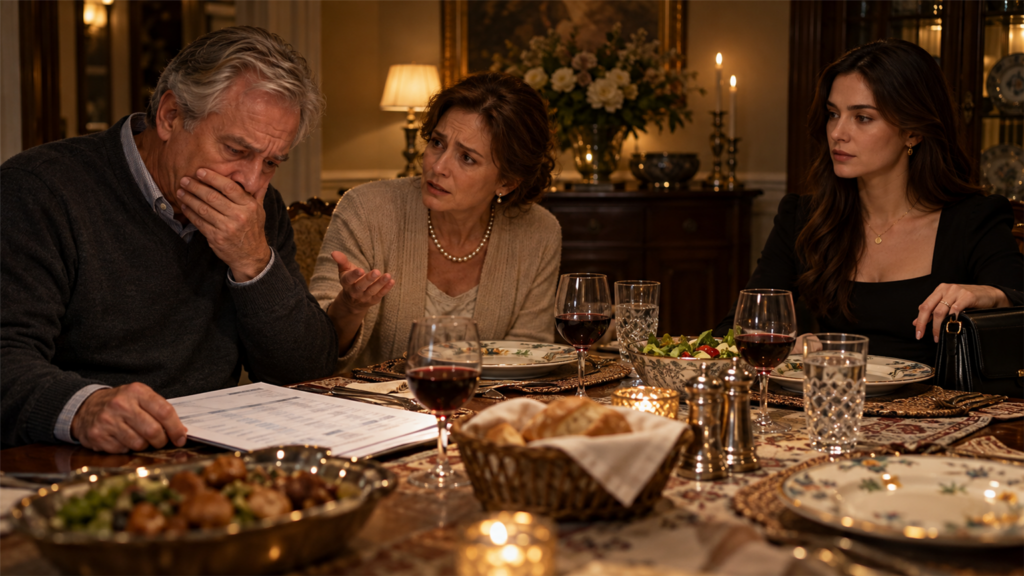
Her expression changed.
“Wait. Those are coming out of your account?”
“Every month.”
Mom suddenly stood.
“Emily, that’s enough!”
Her voice startled everyone.
“You don’t understand what you’ve done. We have a family reputation to protect.”
I looked at her.
“Whose reputation, Mom?”
She said nothing.
I picked up my purse and walked toward the hallway, where family photographs covered the wall. Lauren’s graduation pictures occupied three frames. My restaurant management certificate, which I’d earned while working full-time, had never made it onto that wall.
Before leaving, I stopped beside the kitchen doorway.
“Mom, I won’t be making next month’s payment. You’ll need to arrange your own.”
Dad’s face hardened.
“You wouldn’t dare let your own parents lose their home.”
“I hope it doesn’t come to that.”
Then Lauren spoke.
“Fine. I’ll handle it. I make more than enough.”
Mom turned toward her so quickly that her chair rocked.
“Lauren, don’t promise anything.”
I looked back.
For the first time all evening, my sister wasn’t smiling.
“Why not?” she asked.
Mom’s eyes filled with tears.
“Because there’s something about the house neither of you knows.”
Mom sat down slowly, gripping the edge of the table.
“Two years ago,” she began, “we refinanced the house.”
Dad frowned. “We refinanced before my stroke.”
“We did it again afterward.”
The silence that followed was different from the earlier embarrassment. Even Uncle Richard stopped moving his fork.
Mom explained that when Dad’s medical bills arrived, she’d panicked. She’d taken out a new mortgage with a larger balance, using part of the proceeds to settle overdue expenses and other debts. The monthly payment I’d been covering was higher because of that decision.
“Why didn’t you tell me?” Dad asked.
“Because you were recovering. And Emily was helping.”
I looked at my mother, remembering the afternoon she’d called to ask whether I could cover an unexpected $6,000 expense. She’d said the money was for property taxes.
“That payment in March,” I said. “Was that part of this?”
Mom nodded.
Lauren leaned back. “So how much do you still owe?”
Mom gave her the approximate balance.
My sister’s face drained of color.
“That’s more than I thought.”
Dad rubbed his forehead. “Margaret, we need to call the lender.”
“We do,” I said. “And you need to find out exactly where the money went.”
Mom started crying.
For years, I’d assumed my parents were simply struggling. I hadn’t considered that the bills I paid were also helping conceal financial decisions they refused to discuss.
Lauren looked at me. “You knew about this?”
“No. I knew what Mom told me.”
She stared at her untouched dessert.
Then, unexpectedly, she said, “I thought you were exaggerating about the payments.”
I didn’t answer.
“Emily,” she continued, quieter now, “I really didn’t know.”
That was the first apology she’d come close to offering in years.
Dad looked toward the hallway, where our family photographs hung.
“I’ve made a fool of myself tonight,” he said.
I waited.
He turned back to me.
“You’ve been taking care of us, and I’ve been making jokes about your job.”
His voice cracked.
“I’m sorry.”
I wanted those words to fix everything. Instead, I thought about the nights I’d driven home exhausted, the birthdays I’d missed, and the way Mom always introduced Lauren first.
“Thank you,” I said. “But I’m still stopping the payments.”
Dad nodded.
“I understand.”
Three days later, my parents met with a housing counselor and their lender. They reviewed the mortgage, their retirement income, and the expenses Mom had concealed. They couldn’t afford the house without my help, even after cutting unnecessary spending.
Eventually, they decided to sell.
It wasn’t a dramatic foreclosure or a last-minute rescue. They listed the house, accepted an offer several months later, paid off the mortgage, and moved into a smaller condo they could afford.
Lauren contributed toward the moving expenses. For once, she didn’t announce it to everyone.
Mom called me the evening they finished packing.
“I found your old school pictures,” she said. “The ones we never framed.”
I was sitting at my kitchen table, eating leftover pasta after work.
“Okay.”
“You looked so happy in your restaurant management graduation picture.”
I stared at the wall.
“I was happy, Mom.”
She was quiet.
“I wish I’d celebrated that.”
“So do I.”
Six months after Thanksgiving, I replaced my car. Nothing fancy, just a reliable used Honda with working heat. I also accepted an assistant general manager position at the restaurant where I’d spent eight years proving myself.
On my first day, Dad came by with flowers.
He stood awkwardly near the hostess station, holding a small bouquet wrapped in grocery-store plastic.
“Your mother said you got promoted.”
“I did.”
He looked around the busy dining room.
“You must work hard to keep this place running.”





