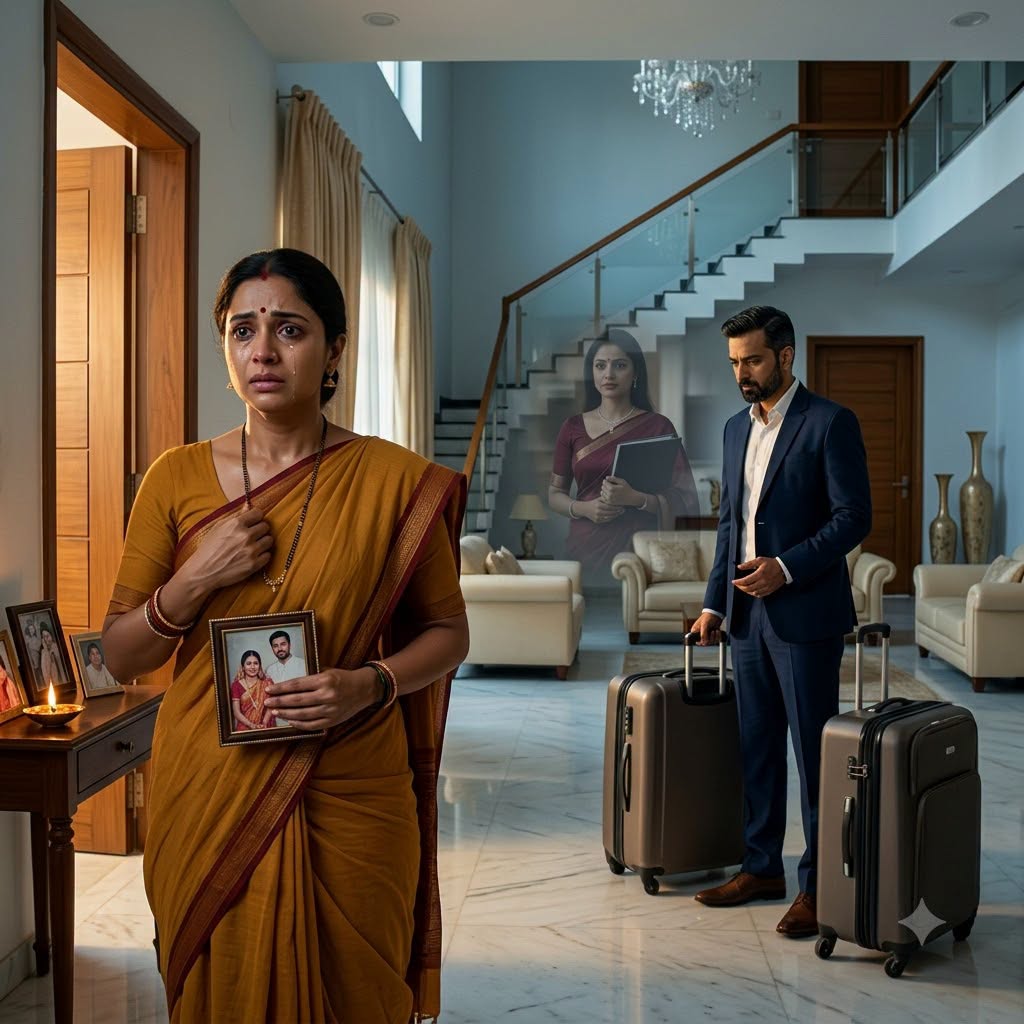
Sometimes she is simply another person standing in the wreckage of the same deception.
Six months later, my divorce proceedings began.
Avinash requested a meeting.
I agreed to see him in Devyani’s office.
He looked older.
The expensive clothes were gone.
His hair had begun greying near his temples.
When he saw me, he began crying.
“Mrinalini, please forgive me.”
I remained silent.
“I made terrible mistakes.”
“Yes.”
“I was under pressure.”
“Yes.”
“I never meant to hurt you.”
I looked directly at him.
“Avinash, you told another woman our daughter was your niece.”
He covered his face.
I continued.
“You watched me sell my mother’s necklace while you were taking money from her.”
His shoulders shook.
“You let me spend three years believing we were building a future together.”
He whispered, “I know.”
I leaned forward.
“Then tell me something.”
He looked up.
“If Yamini had never discovered the property was mine, would you have told either of us the truth?”
He stared at the table.
For a long time, he said nothing.
Then he whispered, “Probably not.”
My heart hurt.
But his answer also gave me peace.
I stood.
“Then there is nothing left to discuss about our marriage.”
He reached toward me.
“Please, Mrinalini.”
I stepped back.
“You can still become a responsible father to Ishwari. But you cannot ask me to rebuild a marriage whose foundation was dishonesty.”
I left the office without looking back.
A year later, the financial proceedings had recovered part of the diverted funds.
Some claims remained unresolved.
The attempted use of my property as collateral had been challenged, and my registered ownership remained unchanged.
Yamini recovered a portion of her money through settlement arrangements and continued pursuing the remainder.
Bhaskar’s business suffered serious consequences.
And Avinash faced ongoing legal and financial responsibilities.
But my life did not wait for every dispute to end.
I returned to work.
I planted jasmine along the courtyard wall.
I finally hung the wooden swing on the veranda.
And I painted Ishwari’s bedroom the bright yellow she had chosen three years earlier.
One evening, she came home from school and found me sitting on the swing.
“Amma,” she said, “do you still love this house?”
I looked around.
The pale green kitchen tiles.
The wide living-room window.
The tulsi plant.
The little courtyard.
“Yes,” I whispered.
She sat beside me.
“Even though Papa isn’t here?”
I smiled.
“Especially because I know what this house really means.”
She looked confused.
I took her hand.
“Your grandfather gave us the land because he wanted us to be safe.”
She nodded.
“And we built the house because we wanted a place where we could live happily.”
She looked toward the doorway.
“Can we still be happy?”
My eyes filled with tears.
I held her close.
“Of course, beta.”
She rested her head against my shoulder.
Then she whispered, “I think we already are.”
That night, after Ishwari went to bed, I opened the old file containing the land documents.
My father’s handwriting appeared on a small note tucked behind the deed.
I had forgotten it was there.
My dear Mrinalini,
People may promise you a beautiful house.
But never forget that a home is not built by the person who spends the most money.
It is built by the person who stays when life becomes difficult.
I began crying.
My father had died before meeting Avinash.
He had never known the pain his daughter would experience.
Yet somehow, his words seemed written for that very night.
I looked toward the courtyard.
The jasmine flowers moved gently in the breeze.
For three years, I had waited for my husband to come home.
I had believed every delayed call was a sacrifice.
Every missing payment was temporary.
Every promise was a brick in our future.
But in the end, the person who returned was not the man I had been waiting for.
And the house he wanted to take was never truly his to claim.
I closed the file.
Then I walked to the front door.
The same door where Avinash had once stood demanding the keys.
I placed my hand against the wood.
For a moment, I remembered how frightened I had been that afternoon.
Then I smiled.
Because now I understood something.
He had returned to India believing he could take possession of a house.
Instead, he had lost the two women who had trusted him, the security he had tried to manufacture, and the family he had treated as an inconvenience.
But I had gained something.
I had regained my dignity.
My peace.
And the courage to stop waiting for someone who had already left in every way that mattered.
The following morning, Ishwari and I planted another jasmine creeper beside the gate.
She pressed the soil gently around its roots.





