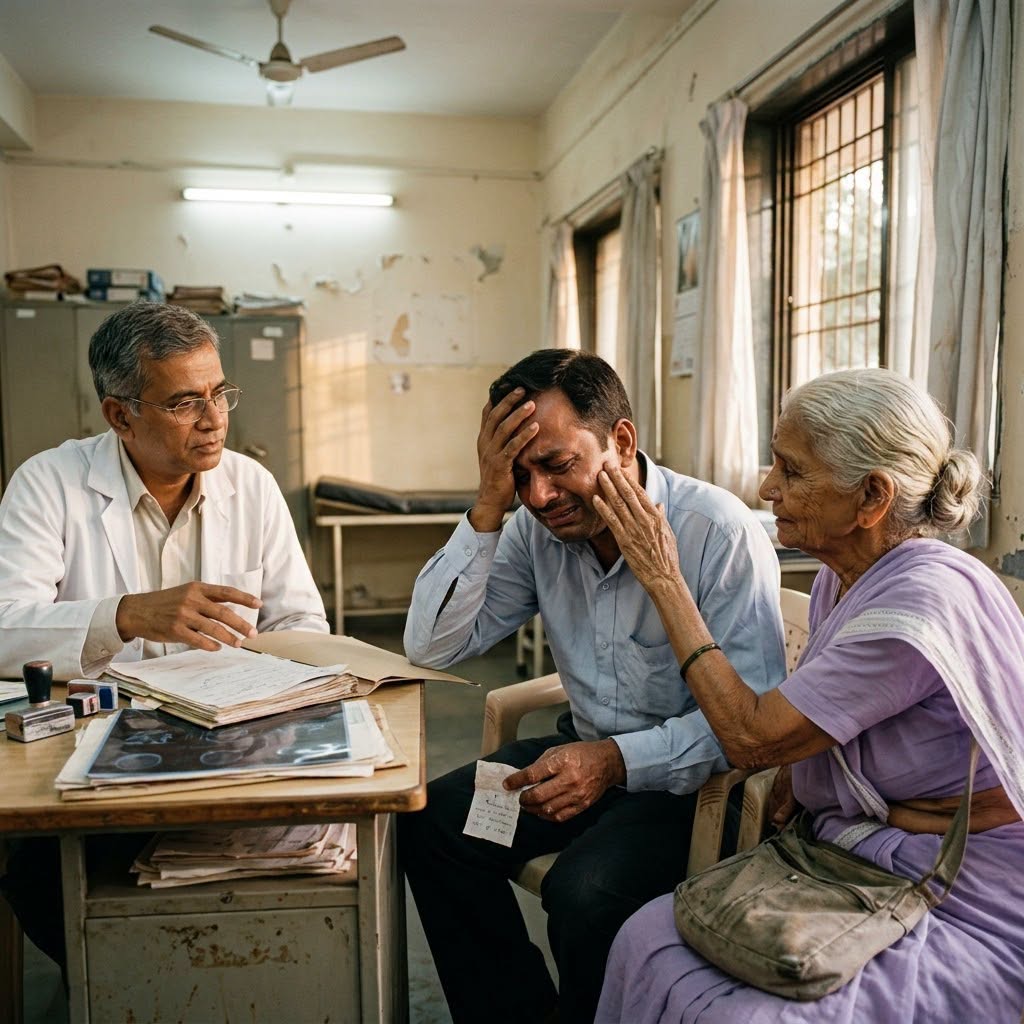
The truth is that I was ashamed.
I was ashamed of leaving.
And then I became too ashamed to return.
I stopped reading.
Tears blurred the page.
Your mother deserved a husband who stood beside her.
You children deserved a father who came home.
I failed all of you.
Please do not let my cowardice become another burden your mother must carry.
If she still remembers me, tell her I am sorry.
And if she does not, please don’t force her to remember a man who caused her so much pain.
I folded the letter.
For a long time, I could not speak.
When we returned to Pune, Amma was sitting beside the window.
She held an old photograph.
I sat beside her.
“Amma?”
She looked up.
“Beta, have you eaten?”
I smiled through tears.
“Yes.”
She touched my cheek.
“You look tired.”
I took her hand.
“Amma, I found out about Papa.”
Her expression changed.
For a moment, she looked frightened.
Then she whispered, “Nandkumar?”
I nodded.
“He died last year.”
She stared at me.
Then slowly lowered her eyes.
A tear rolled down her cheek.
“I waited so long.”
I felt my throat close.
She continued.
“Every evening, I thought he might come.”
I began crying.
She looked at me.
“Did he love you?”
I swallowed.
“I think he did, Amma. But he didn’t know how to come back.”
She nodded slowly.
Then whispered, “I hope he found peace.”
I stared at her.
Even after everything, she wished him peace.
I took her hand.
“Amma, what about you?”
She looked confused.
“What about me?”
I began crying harder.
“Who wished you peace?”
Over the following months, our lives changed.
The specialist explained that Amma’s difficulties were consistent with a progressive dementia syndrome, and further assessment helped us understand her needs.
There was no simple cure.
But there were ways to support her.
We arranged medication reviews.
A safer kitchen.
Clear labels on cupboards.
A large clock showing the day and date.
Family photographs with names written beneath them.
We established routines.
We learned not to argue when she became confused.
We learned to answer repeated questions patiently.
We learned that correcting every mistake was less important than helping her feel safe.
And most importantly, we learned to listen.
One evening, Madhav came into the kitchen.
I was checking whether the gas stove was off.
He stood beside me.
“Papa?”
“Yes?”
“Dadi left the light on again.”
I looked toward the ceiling.
The bulb was glowing.
For a moment, I remembered the morning I had scolded her.
The frightened look in her eyes.
The way she folded her saree.
The quiet apology.
I felt tears rising.
Then I looked at my son.
“It’s all right.”
He smiled.
“I already turned it off.”
I placed my hand on his shoulder.
“Thank you.”
He hesitated.
“Papa, will Dadi forget me too?”
My throat tightened.
“Maybe someday.”
His eyes filled.
“Then what should I do?”
I knelt beside him.
“Love her anyway.”
As the months passed, Amma’s memory became less reliable.
Some mornings, she recognized everyone.
Other mornings, she believed I was still eleven.
Once, she asked whether I had finished my homework.
I smiled.
“Yes, Amma.”
She looked pleased.
“Good boy.”
Another day, she mistook Kaveri for Bhairavi.
My wife gently corrected her.
Then made tea.
Sometimes Amma became frightened because she could not remember where she was.
We learned to sit beside her.
Hold her hand.
Speak slowly.
And remind her that she was home.
On her seventy-fifth birthday, we organized a small celebration.
Nothing extravagant.
Just family.
Bhairavi brought flowers.
Shashidhar brought sweets.
Ishwari decorated the living room with photographs.
Madhav baked a cake with Kaveri.
When Amma entered, she looked surprised.
“Whose birthday?”
I smiled.
“Yours.”
She laughed.
“Mine?”
“Yes, Amma.”
She looked around.
Then whispered, “All these people came for me?”
My eyes filled.
“Of course.”
She smiled like a little girl.
And for one beautiful moment, I saw the mother I remembered.
The woman who stitched clothes beneath a yellow bulb.
The woman who sold her bangles.
The woman who held our family together with hands that never seemed to rest.
After the cake, I sat beside her.
She touched my face.
“Avinash?”
“Yes, Amma.”
She smiled.
“My son.”
I nodded.
She looked at me carefully.
Then whispered, “You have grey hair.”
I laughed through tears.
“I know.”
She touched my cheek.
“You grew up.”
My throat closed.
“Yes, Amma.”
She smiled.
“Are you happy?”
The question broke me.
For years, I had asked whether she had taken her medicines.
Whether she had eaten.
Whether she had switched off the lights.
But I could not remember asking whether she was happy.
I took her hand.
“I am, Amma.”
She nodded.
“Good.”
Then she whispered, “That’s all I ever wanted.”





