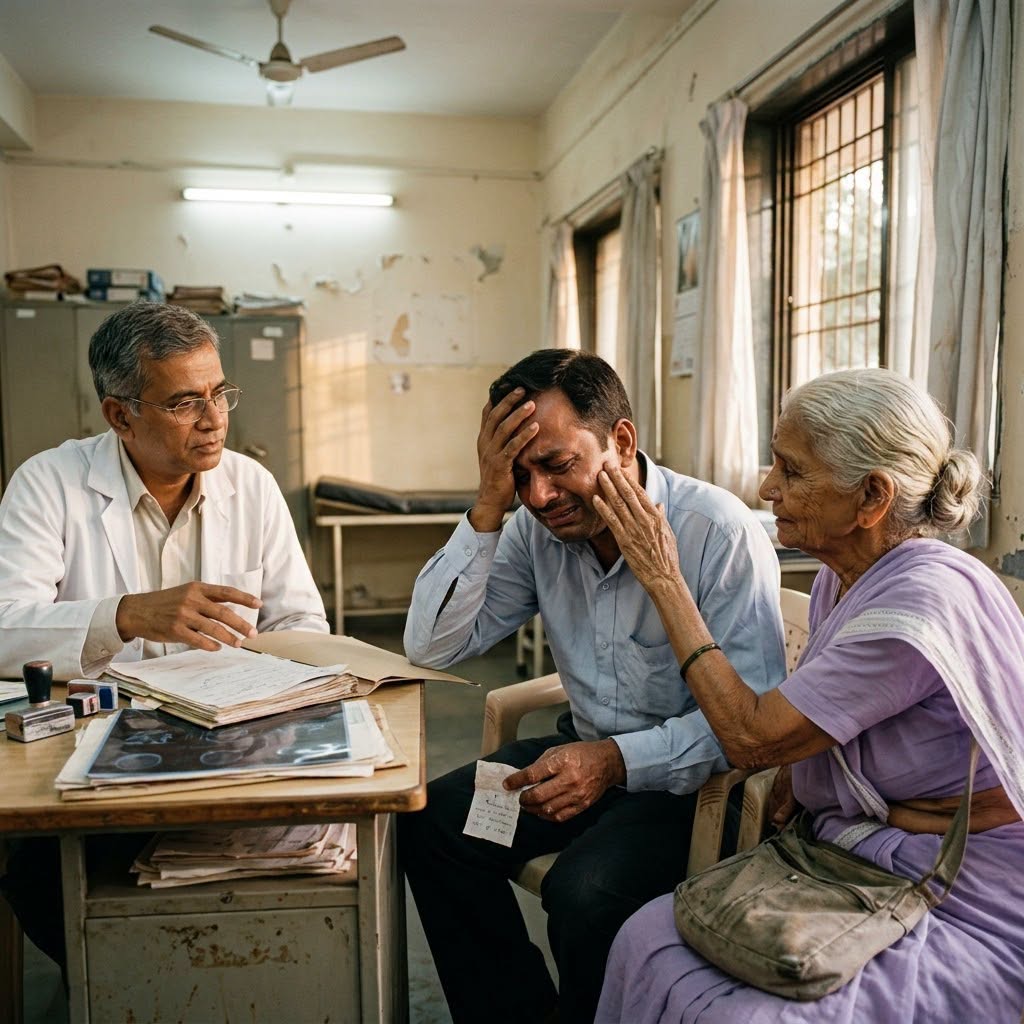
A year later, Amma no longer recognized me every day.
Some mornings, she called me Nandkumar.
Other mornings, she called me her little boy.
Sometimes she simply smiled without knowing my name.
But she still reached for my hand.
And I learned that recognition was not the only language of love.
One evening, I sat beside her bed.
She was holding the old photograph.
The one with my father and his brother.
I gently placed it on the table.
Then I took her hand.
“Amma, do you know who I am?”
She studied my face.
For a long moment, she said nothing.
Then she smiled.
“I don’t remember your name.”
My eyes filled.
“But I know you.”
I swallowed.
“How?”
She placed her hand over her heart.
“Here.”
I began crying.
She looked concerned.
“Why are you sad?”
I shook my head.
“I’m not sad, Amma.”
She smiled.
“Then sit with me.”
I sat.
And for the next hour, we watched the evening light fade through the window.
Sometimes I think about that kitchen light.
Such a small thing.
A bulb left burning.
A refrigerator door not properly closed.
A cup of tea forgotten beside the sink.
I had treated those mistakes as evidence that my mother was becoming careless.
But she wasn’t careless.
She was frightened.
She was fighting to hold on to a world that was slowly becoming unfamiliar.
And while she was trying desperately to remember my face, I had been too busy counting the cost of electricity.
I cannot change that morning.
I cannot take back the words I spoke.
I cannot restore every memory she has lost.
But I can decide what happens next.
I can be patient.
I can be gentle.
I can hold her hand when she is frightened.
I can answer the same question twenty times without making her feel ashamed.
And I can teach my children that caring for an aging parent is not simply paying bills or buying medicines.
It is protecting their dignity when they can no longer protect it themselves.
Last week, I found Amma sitting near the kitchen window.
The ceiling light was on.
It was morning.
Sunlight filled the room.
She looked at me nervously.
“Beta, did I forget something?”
I glanced at the light.
Then at her face.
The same face that had watched over me through childhood fevers.
The same eyes that had cried when I left for college.
The same hands that had worked until midnight so I could have a better life.
I smiled.
“No, Amma.”
She looked relieved.
Then asked, “Would you like some tea?”
I sat beside her.
“Yes.”
She began to stand.
I gently stopped her.
“Today, I’ll make it.”
She smiled.
“You know how?”
I laughed.
“You taught me.”
She looked pleased.
And as I stood at the stove, I left the kitchen light on.
Not because electricity was free.
But because I finally understood that some things were worth far more than the cost of a bulb.
My mother had spent her life making sure I never felt alone.
Now it was my turn.
Even if one day she forgot my name.
Even if she forgot my face.
Even if she forgot that I was her son.
I would remember for both of us.
And I would never again make her apologize for needing me.
If your mother began forgetting your name, leaving lights on, and making mistakes she once never made, would you have the patience to care for her with the same love she gave you as a child? And if you discovered she had hidden a heartbreaking family secret for decades, would you forgive her? Share what you would have done in Avinash’s place in the comments, and follow the page for more emotional stories about family, sacrifice, forgiveness, and the love that remains even when memories begin to fade.





