“…the baby I was told had died twenty-seven years ago is alive.”
My mother’s voice was barely a whisper.
But those words seemed to shake the walls of our home.
I stared at her.
“What?”
She pressed a trembling hand against her chest.
“My child, Vedika. Your younger sister.”
I looked at the photograph again.
The newborn wrapped in white.
The little black thread around her wrist.
Then I looked at my father.
He was staring at the floor.
“You knew?” I asked.
He said nothing.
“Pitaji, did you know?”
Finally, he nodded.
My mother began crying.
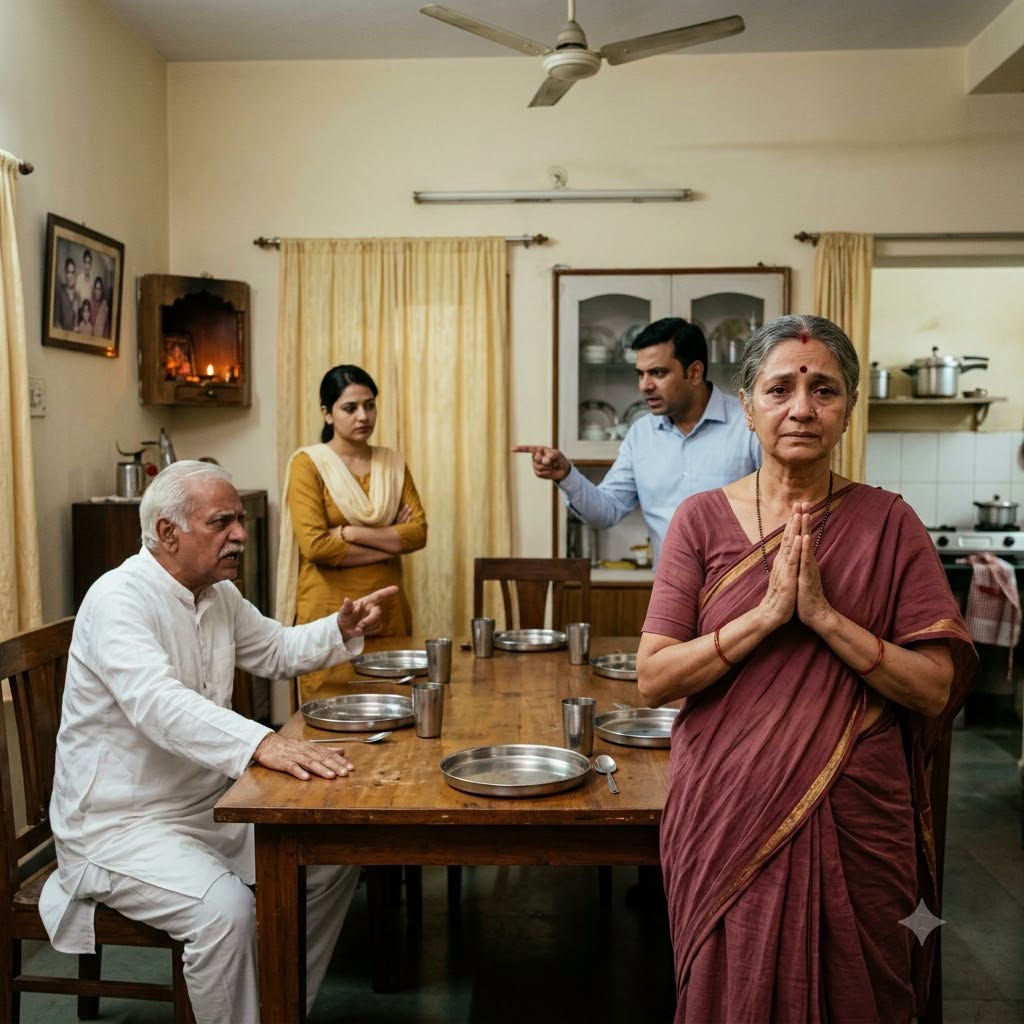
And for the first time in my life, I watched my father look afraid of the woman who had served him dinner for thirty-nine years.
Bhairavi gently pulled out a chair.
“Kaveri, sit down. Let me explain.”
But my mother shook her head.
“No. I’ve been sitting quietly for twenty-seven years. Today, I will tell my children myself.”
She turned toward me.
“When you were seven, Vedika, I became pregnant again.”
I remembered almost nothing about that time.
Only my grandmother’s house.
The smell of her sandalwood soap.
And the terrible loneliness of waking up each morning without my mother.
“I was forty-three,” Maa continued. “The pregnancy was difficult. Your father didn’t want another child. He was worried about money, about my health, about what people would say.”
My father interrupted.
“The doctors said it was dangerous!”
Maa looked at him.
“Yes, Nandkumar. But the baby survived.”
His face collapsed.
She continued.
“I went into premature labour while visiting Nagpur. Bhairavi helped get me to the hospital. The baby was born very small. She needed special care.”
My mother touched the photograph.
“But she cried, Vedika. I heard her cry.”
Tears began falling down her face.
“I held her once. I counted her fingers. I kissed her forehead. Then the nurses took her away.”
I swallowed.
“What happened?”
Maa closed her eyes.
“Three days later, your father came to the hospital. He told me our daughter had developed complications and died.”
I looked at him.
My father was trembling.
“I believed him,” Maa whispered. “He was my husband. Why wouldn’t I believe him?”
Bhairavi opened the folder.
“Years later, I discovered that the baby hadn’t died.”
The room went silent.
My mother looked directly at my father.
“Tell her what you did, Nandkumar.”
He covered his face.
And then, after twenty-seven years, the truth finally emerged.
He had arranged for our newborn sister to be placed with a childless couple.
The couple had been told that the mother had agreed to the adoption.
My mother had never consented.
The signatures on the paperwork were not hers.
My father had helped conceal the truth.
“I thought I was doing what was best,” he whispered.
My mother stared at him.
“Best for whom?”
He began crying.
“We already had two children. Your health was poor. I thought another baby would destroy everything.”
She stepped closer.
“So you destroyed me instead?”
Nobody spoke.
“You watched me light a diya every year for a daughter you knew was alive.”
His shoulders shook.
“You watched me cry on her birthday.”
“Kaveri, please—”
“You let me mourn a living child.”
I had never heard my mother speak with such pain.
And then I remembered something.
Every year, on August seventeenth, Maa prepared a small bowl of kheer.
She placed it beside the puja shelf.
When I asked whom it was for, she always said, “Someone I miss.”
I had assumed she meant a relative.
Now I understood.
For twenty-seven years, my mother had been feeding the memory of a daughter she believed was dead.
I looked at my father.
“Did you ever try to find her?”
He shook his head.
“Did you even know her name?”
His silence answered me.
My mother wiped her tears.
“Her name is Ananya.”
I looked at her.
“How do you know?”
Bhairavi handed me another photograph.
A woman stood outside a hospital wearing a white coat.
She had dark eyes.
A gentle smile.
And an expression I recognized immediately.
It was my mother’s face.
Only younger.
Beneath the photograph were the words:
Dr. Ananya Rao — Pediatrician.
My heart began pounding.
“She’s a doctor?”
Maa nodded through tears.
“She works with children.”
I covered my mouth.
The daughter my mother had once dreamed of becoming a nurse had grown into a doctor.
But the coincidence was not what broke me.
It was the way Maa touched the photograph.
Not like someone admiring a stranger.
Like a mother afraid her child might disappear again if she let go.
“How did she find you?” I whispered.
Bhairavi answered.
“Ananya’s adoptive parents told her the truth about her adoption when she was young. They had always believed the original documents were genuine. After her adoptive mother passed away, she began researching her birth records.”





