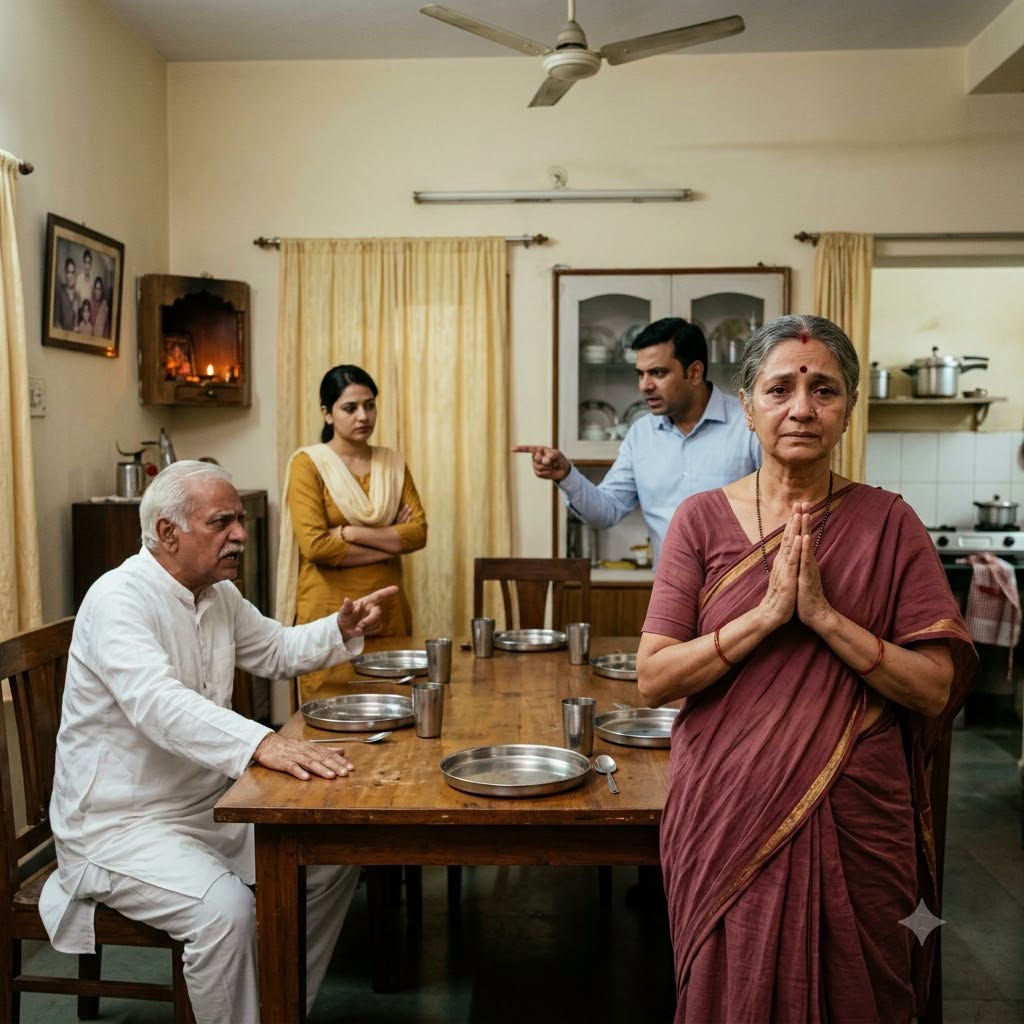
She looked at my father.
“Eventually, she discovered inconsistencies. With legal assistance and access to the appropriate records, she traced Kaveri.”
My mother began crying again.
“She wrote me a letter.”
“When?”
“Last week.”
I stared at her.
“Last week?”
She nodded.
“She told me she wasn’t angry with me. She only wanted to know whether I had ever thought about her.”
My mother’s voice broke.
“How could I tell her I had thought of nothing else?”
Then she said something that made my chest ache.
“On Monday evening, I read her letter for the seventh time. Your father called from the dining room and complained that his tea was cold.”
She looked toward the kitchen.
“And suddenly, I couldn’t do it anymore.”
I understood.
The cooking.
The cleaning.
The endless service.
They had become the walls of a prison my mother had built around her grief.
For twenty-seven years, she had tried to be such a good wife and mother that nobody would notice the part of her that had died.
On Tuesday, she had finally opened the door.
The following afternoon, Ananya arrived.
I remember every second.
The clock showed three-seventeen.
Rain tapped softly against the balcony railing.
Maa had been standing near the front door for nearly an hour.
She wore her best green saree.
Her hair was neatly braided.
But her hands would not stop trembling.
When the bell rang, I opened the door.
A woman stood outside holding a small overnight bag.
She was twenty-seven.
Her eyes were wet.
For a moment, she looked at me.
“Vedika?”
I nodded.
She smiled faintly.
“I think I’m your sister.”
I began crying before I could answer.
Then Maa appeared behind me.
And everything stopped.
Ananya looked at her.
Maa looked at Ananya.
Neither moved.
Then Ananya whispered one word.
“Maa?”
My mother made a sound I had never heard before.
It was not quite a cry.
Not quite a scream.
It was the sound of twenty-seven years of longing leaving one human heart.
She rushed forward.
Ananya dropped her bag.
They embraced in the doorway.
Maa held her so tightly that I wondered how either could breathe.
“My baby,” she kept saying. “My little girl. My Ananya.”
Ananya buried her face in Maa’s shoulder.
“I thought you didn’t want me.”
My mother pulled back.
She held Ananya’s face between her palms.
“Never. Not for one second.”
Ananya began sobbing.
“I thought you gave me away.”
Maa shook her head desperately.
“They told me you died.”
Then she kissed her daughter’s forehead.
Again.
And again.
As though trying to give her every kiss she had missed.
I stood beside them, crying.
Behind us, Avinash had come out of his bedroom.
For once, my brother had nothing to say.
Gaurika stood beside him, holding Pradyumna’s hand.
Even the little boy seemed to understand that something extraordinary was happening.
Then my father appeared.
Ananya looked over Maa’s shoulder.
Her expression changed.
“Is that him?”
My mother nodded slowly.
Ananya stepped backward.
My father tried to speak.
“Beta—”
“Please don’t call me that.”
He froze.
Ananya’s voice trembled.
“I have spent years wondering why my birth parents gave me away. I imagined poverty, illness, desperation. I never imagined my mother had been told I was dead.”
My father lowered his eyes.
“I made a terrible mistake.”
Ananya looked at him.
“A mistake is forgetting a birthday. You took away twenty-seven years.”
He began crying.
But Ananya turned away.
“I came to meet my mother. I’m not ready to speak to you.”
Nobody forced her.
That evening, for the first time in our family’s history, we prepared dinner without asking Maa to lift a finger.
I cooked dal.
Gaurika made rotis.
Avinash chopped vegetables.
Pradyumna arranged the plates.
My father remained in his room.
And Maa sat at the dining table beside Ananya.
They talked for hours.
About school.
About childhood illnesses.
About birthdays.
About Ananya’s adoptive parents.
Her mother had been a teacher.
Her father, a railway engineer.
They had loved her deeply.
“My mother used to tell me I had two birthdays,” Ananya said. “The day I was born and the day I came home.”
Maa smiled through tears.
“I’m glad they loved you.”
Ananya took her hand.
“They did. They never made me feel unwanted.”
Then she hesitated.
“But there was always a question inside me.”
“What question?”
“Whether the woman who gave birth to me ever looked at another little girl and wondered if I looked like her.”
Maa touched her cheek.
“Every day.”
After dinner, Ananya opened her bag.
She took out a small wooden box.
Inside was a black thread.
My mother gasped.
“The thread!”
Ananya smiled.
“My adoptive mother kept it. She said I was wearing it when I came home.”
Maa hurried into her bedroom.





