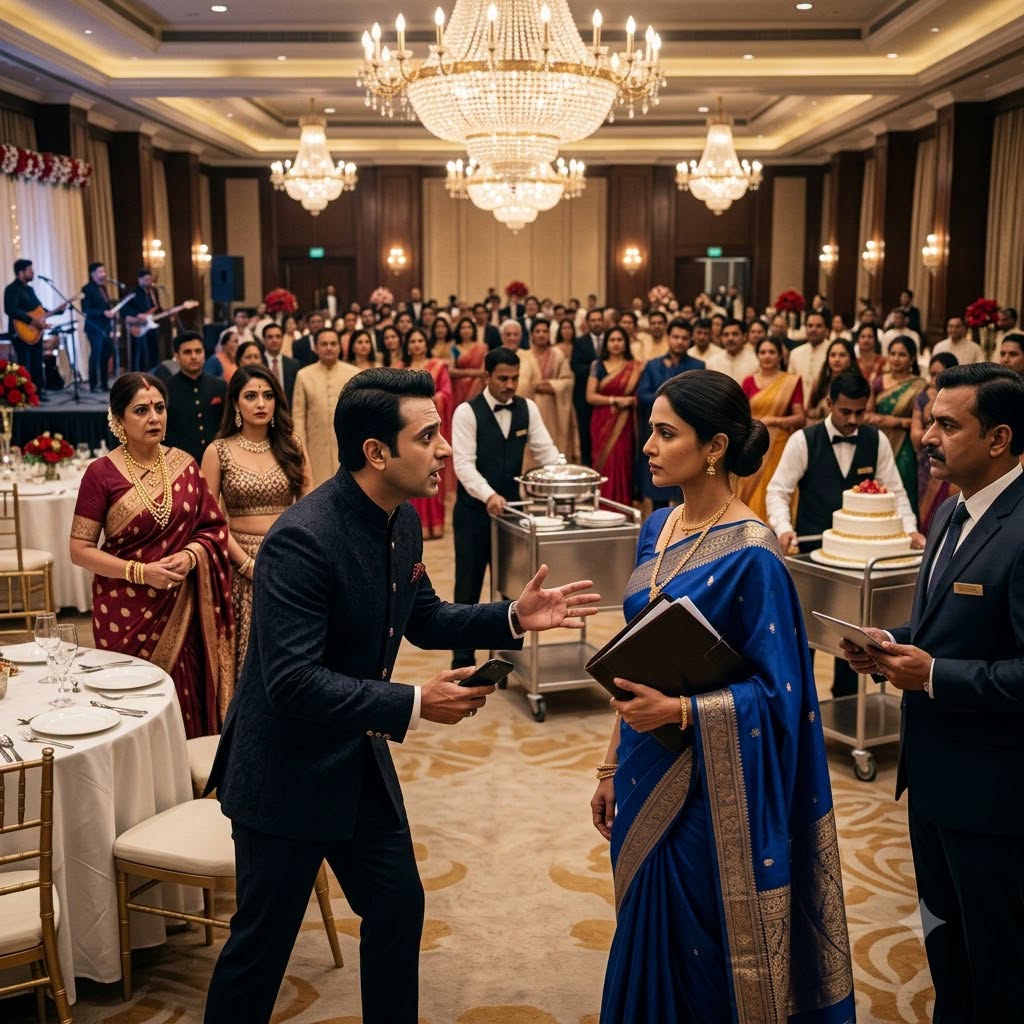
I answered, “They already watched my husband humiliate me before four hundred people. I think they have enough information.”
Eventually, the marriage ended.
The property disputes continued separately until the contested claims were resolved.
My commercial building remained mine.
My inherited warehouse interest was protected.
The trust retained its own rights.
The rental payments that had been diverted were accounted for through a settlement.
Not every rupee returned.
Not every wrong received a perfect punishment.
Real life rarely provides such tidy endings.
But I stopped losing money simply because somebody called me family.
Two years after the banquet disaster, I visited Jaipur for the opening of a new enterprise.
Not Rathore Textiles.
Something smaller.
Something I had chosen.
The warehouse complex had been renovated with the trust’s cooperation.
Part of it became affordable workspaces for women running tailoring, embroidery and textile businesses.
Another section housed a training centre.
We named it the Mrinalini–Kaveri Women’s Enterprise Centre.
Mrinalini, the woman whose courage had helped protect the property.
Kaveri, my mother, who had taught me that dignity mattered even when nobody else could see it.
At the opening, I stood before nearly two hundred people.
Not four hundred.
No expensive orchestra.
No silver serving dishes.
Just tea, samosas and women who had come carrying samples of their work.
One young widow showed me embroidered dupattas.
A mother of two asked about renting a sewing machine.
A woman my age told me she wanted to restart her business after twenty years of marriage.
I looked around.
For most of my life, I had believed my value lay in helping the Rathores appear successful.
Now I was helping women become successful in their own names.
Ishwari stood beside me.
Pradyumna arrived with flowers.
He had been working hard to rebuild the textile business on a smaller scale.
We still had difficult conversations.
But he no longer hid behind his father.
That mattered.
After the ceremony, he took my hand.
“Amma, I need to tell you something.”
My heart tightened.
“What?”
He smiled.
“The workers received their pending wages today.”
I stared at him.
“All of them?”
“The remaining verified amounts. We finished the last settlement.”
I began crying.
He hugged me.
“I remembered what you said. That the people who carried the company deserved to be paid before anyone celebrated saving it.”
I held him tightly.
That was the first time I felt something from the old Rathore family had truly been rescued.
Not the name.
Not the showroom.
A value.
Three years after the anniversary party, Devyani Maaji died.
I attended her funeral.
Not because I had forgotten her cruelty.
Because I wanted to say goodbye without carrying hatred into the rest of my life.
Bhairavi barely acknowledged me.
Shashidhar looked older.
Smaller.
He approached me after the prayers.
“You look well.”
“I am.”
He hesitated.
“I never thanked you for helping Pradyumna.”
I looked at him.
“He’s our son.”
“Yes.”
Then he whispered, “I was wrong that night.”
I waited.
“About the party?”
“About you.”
My throat tightened.
He looked down.
“You weren’t useless.”
For a moment, I almost laughed.
Twenty-eight years of marriage.
Millions of rupees.
Endless unpaid work.
And at sixty-three, my former husband had finally discovered that I was not useless.
I nodded.
“I know.”
He looked up.
Perhaps he expected forgiveness.
Perhaps he wanted me to say it was all right.
En cambio, le dije: “Espero que aprendas a decirle eso a la próxima persona que te ayude”.
Entonces me marché.
Esa noche regresé a mi apartamento.
No era enorme.
Dos habitaciones.
Un balcón lleno de plantas.
Una cocina donde cocinaba solo cuando me apetecía.
En la pared colgaba la fotografía de mi padre.
Junto a él estaba el primer cheque emitido por el centro de emprendimiento femenino a una mujer que había completado nuestro programa de formación.
Me senté con una taza de té y pensé en el salón de banquetes.
Las rosas blancas.
El shehnai.
La silla vacía.
La voz de mi marido resonaba a través del micrófono.
Las mujeres son más felices cuando se mantienen dentro de sus capacidades.
Sonreí.
En una cosa tenía razón.
Fui más feliz cuando finalmente comprendí mis capacidades.
Sabía administrar el dinero.
Negociar contratos.
Proteger la propiedad.
Construir negocios.
Criar hijos.
Cuidar de las personas.
Y, cuando sea necesario, aléjese.
Lo más importante que aprendí de los Rathore no fue la cena que cancelé, la propiedad que protegí ni el dinero que recuperé.
Fui yo.
La mujer que había desaparecido tras veintiocho años de servicio.
La mujer que había olvidado la advertencia de su padre.
La mujer que una vez creyó que sentarse a la mesa familiar era un privilegio que tenía que ganarse.
Ahora había construido mi propia mesa.
Y nadie que estuviera sentado allí tuvo que renunciar a su dignidad para merecer un lugar.





