“Ma, he taught me to ride a bicycle. He sat outside my examination hall. He sold his scooter to pay my college fees.”
My voice broke.
“Nothing could have made him less my father.”
She began sobbing.
“I know that now.”
I looked toward the window.
“I wish you had trusted me with the truth.”
“So do I.”
We sat in silence.
Then she whispered, “There is something else.”
I closed my eyes.
“Ma, please.”
“I don’t want you to discover another part of your life from a stranger.”
I looked at her.
She reached into her handbag and removed an old photograph.
Two newborn babies lay beside each other.
One wore a pink hospital band.
The other blue.
My brother and me.
I touched the photograph.
For thirty-four years, I had believed I was an only child.
Now I was looking at a boy who had entered the world beside me and disappeared before I could know him.
“What was his name?”
My mother smiled through tears.
“I wanted to call him Rohan.”
I stared at the photograph.
“Rohan.”
For some reason, saying his name hurt more than hearing the entire story.
Two days later, I was discharged.
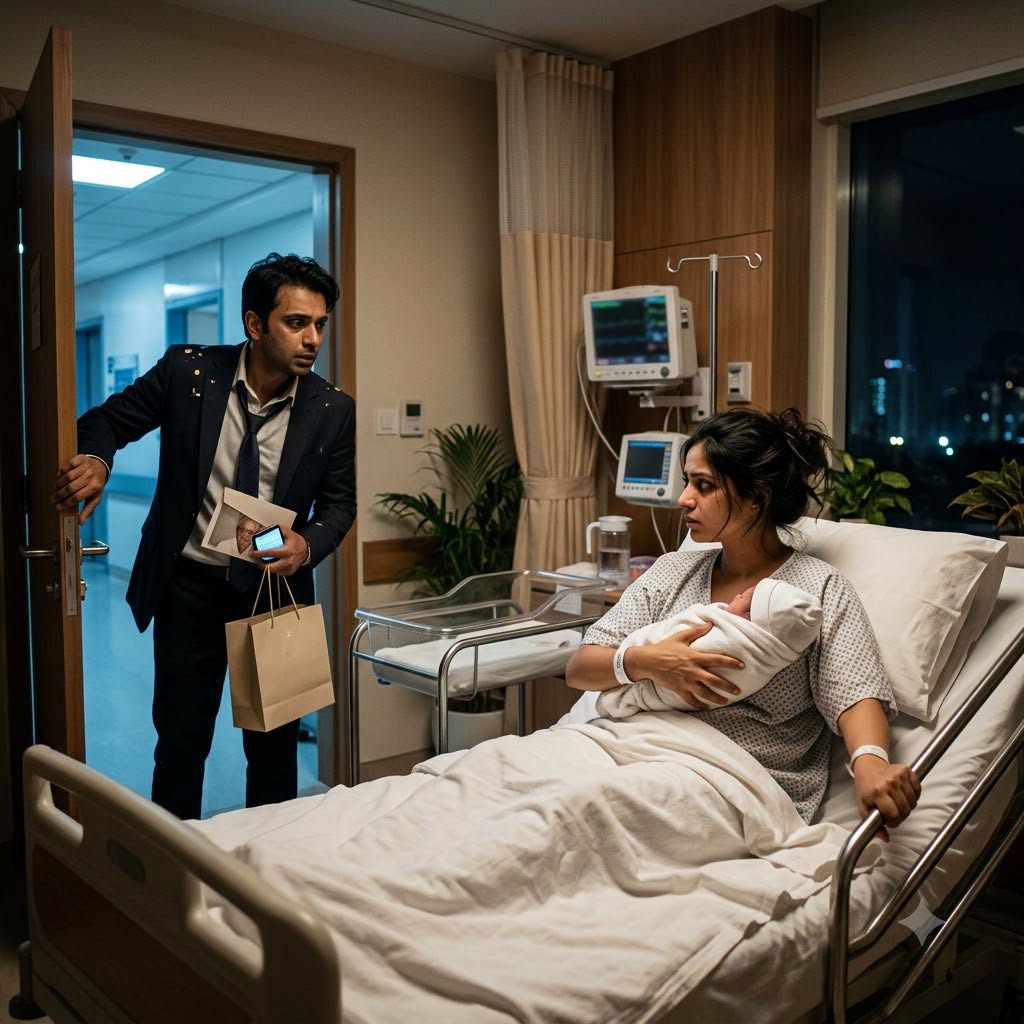
Madhav came to the hospital with flowers.
I did not accept them.
He looked exhausted.
“Can we talk?”
I handed Aarav to Gaurika.
“Five minutes.”
He followed me into the corridor.
“I ended things with Devyani.”
I stared at him.
“You think that is the first thing I want to hear?”
He swallowed.
“No.”
“Then why say it?”
“Because I want you to know I’m trying to fix this.”
I looked at him for a long time.
“You missed our son’s birth.”
His eyes filled.
“I know.”
“You knew I was in labor.”
“Yes.”
“You chose to stay at her birthday party.”
He began crying.
“I made a terrible mistake.”
“No, Madhav. You made a decision.”
He looked down.
“That matters.”
He wiped his face.
“I was selfish.”
“Yes.”
“I was a coward.”
“Yes.”
“I don’t expect you to forgive me immediately.”
I almost laughed.
“Immediately?”
He looked at me.
“I don’t know whether I will ever forgive you.”
His face collapsed.
I continued.
“You don’t get to turn my father’s identity into the reason you came back. You came back because you were frightened by what you discovered.”
He opened his mouth.
Then closed it.
“You didn’t come back because you suddenly remembered your wife was giving birth.”
He whispered, “You’re right.”
I nodded.
“Good.”
Then I returned to my son.
The next several weeks were exhausting.
Aarav cried at night.
I struggled with breastfeeding.
My stitches hurt.
My emotions changed from hour to hour.
Some mornings I felt strong.
Other mornings I cried because I couldn’t find a clean burp cloth.
Gaurika stayed with me.
Ma cooked.
Madhav sent money and asked for updates.
I allowed him to see Aarav during arranged visits.
I did not allow him to move back into our bedroom.
For once, I refused to confuse forgiveness with convenience.
Meanwhile, Harivansh began investigating the nursing home.
He hired independent legal counsel.
Old records were recovered.
A retired nurse agreed to speak.
The truth was uglier than any of us expected.
Harivansh’s father had arranged for the male twin to be transferred to a couple who had been unable to conceive.
The Sarans.
The arrangement had been concealed through falsified records and payments to hospital staff.
My mother had been told her son died.
Harivansh had been told his unborn child was no longer his concern.
And the Sarans had raised Raghavendra as their own.
I asked the lawyer one question.
“Did the Sarans know he had been taken from his mother?”
He answered carefully.
“The evidence suggests they knew the adoption was irregular. We are still determining what they were told.”
That distinction mattered.
I had spent enough of my life watching people turn suspicion into certainty.
I wanted facts.
Not another family legend.
Raghavendra agreed to a DNA test.
So did Harivansh.
So did I.
The results confirmed what the records suggested.
Raghavendra and I were biological twins.
Harivansh was our biological father.
When I received the report, I sat on the edge of my bed holding Aarav.
My son was sleeping.
I looked at the paper.
Then at his face.
“Your mama exists,” I whispered.
A week later, I met Raghavendra.
We chose a quiet garden café in Pune.
He arrived first.
When I saw him, I stopped walking.
It was like looking into a distorted mirror.
The same eyebrows.
The same smile.
Even the way he held his cup.
He stood.
“Vaidehi?”
I nodded.
For a moment, neither of us moved.
Then he said something that made me cry.
“I always wondered why I felt like somebody was missing.”
I covered my mouth.





