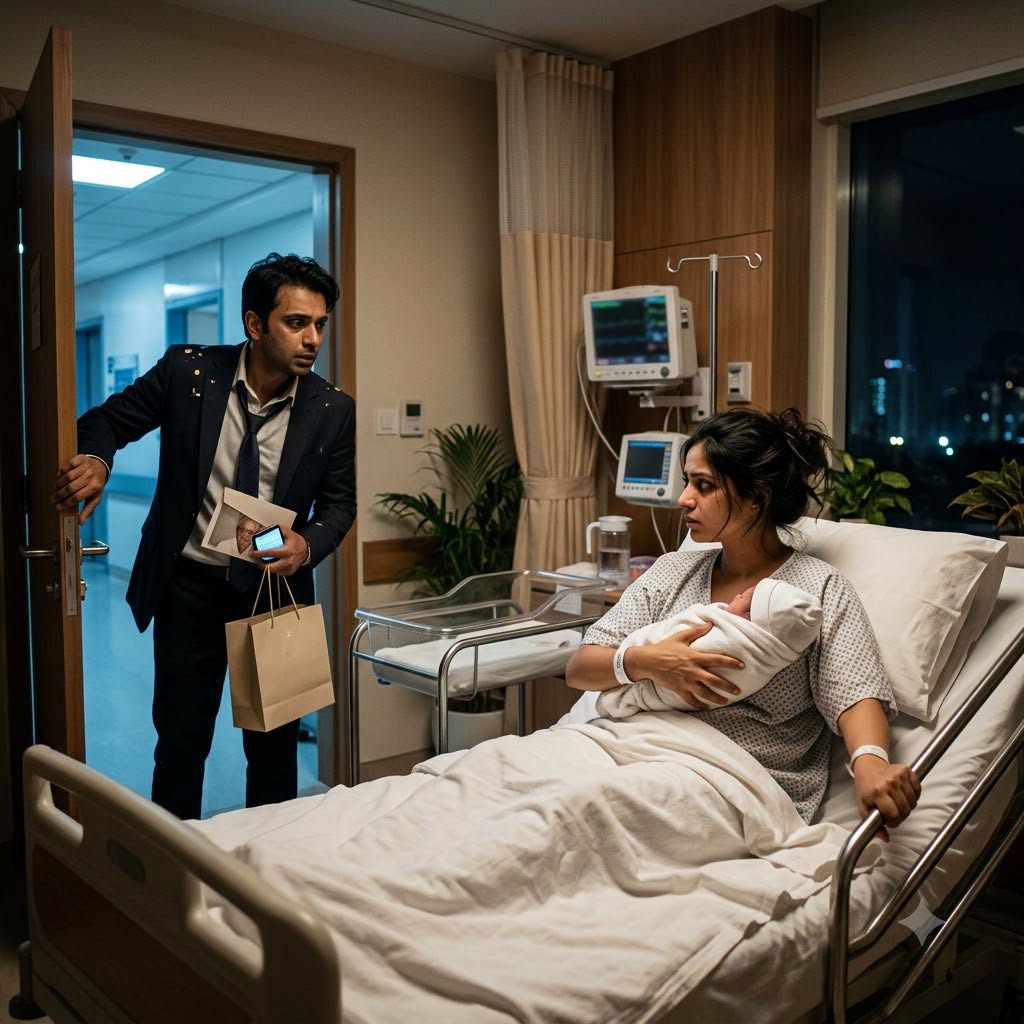
He stepped closer.
“May I hug you?”
I nodded.
He held me.
And I cried for thirty-four lost birthdays.
Thirty-four Raksha Bandhans.
Thirty-four years of believing I had no brother.
He cried too.
We sat for hours.
He told me about his childhood.
His school.
His adoptive parents.
His marriage.
His work.
I told him about Baba.
About Gaurika.
About Aarav.
And about the night we were born.
At one point, he smiled sadly.
“Do you hate my parents?”
I thought carefully.
“I hate what was done.”
He nodded.
“But I don’t know yet how much they understood.”
He looked relieved.
“Thank you.”
I touched his hand.
“None of this is your fault.”
He began crying again.
Over the next year, the investigation continued.
The hospital’s old records became part of a formal inquiry.
The surviving people involved were questioned.
Some documents had disappeared.
Others had been deliberately altered.
Harivansh provided evidence about his father’s role.
He did not try to protect the Vardhan name.
That mattered to me.
Because I had no interest in exchanging one powerful family’s silence for another.
Harivansh also asked whether he could be part of my life.
I told him the truth.
“I already had a father.”
He nodded.
“I know.”
“His name was Mahesh Kulkarni.”
“I know.”
“He loved me.”
Harivansh’s eyes filled.
“Then I owe him more than I can ever repay.”
I looked at him.
“You can’t repay him.”
He lowered his head.
“But you can respect him.”
“I will.”
Slowly, we began building something.
Not the relationship we should have had.
That was gone.
But something honest.
He visited Aarav.
He listened when I spoke about Baba.
He never asked me to change my surname.
He never asked me to call him Papa.
One evening, while we were looking through old photographs, I asked him whether he had ever married.
He shook his head.
“Once, I thought I would marry your mother.”
He smiled sadly.
“After that, I spent too much time building businesses and not enough time understanding why I was lonely.”
I looked at him.
“You had a family.”
“I did.”
His eyes filled.
“I just didn’t know where they were.”
Two years after Aarav’s birth, Madhav and I finalized our divorce.
He had attended counseling.
He had apologized repeatedly.
He had become a more present father.
But I had learned that someone could change and still not be the person I wanted to share my life with.
We agreed on arrangements for Aarav.
Madhav remained involved in his son’s life.
I never spoke badly about him to our child.
But I did not return to him.
Some people called me stubborn.
Others said I should have forgiven him because he was trying.
I stopped explaining.
I had spent too many years being told what a good wife should tolerate.
I wanted to learn what a peaceful woman could choose.
On Aarav’s third birthday, we held a small celebration.
Ma made kheer.
Gaurika decorated the living room.
Raghavendra brought a ridiculous toy train.
Harivansh arrived carrying a storybook.
Madhav came later with Aarav’s favorite building blocks.
For a few hours, people who had once been connected by lies stood together because they loved one little boy.
It was not perfect.
But it was honest.
After the guests left, I found Harivansh standing beside Baba’s photograph.
He was looking at it quietly.
I approached him.
“He would have liked Aarav.”
Harivansh nodded.
“He must have been a good man.”
“He was.”
The old man’s eyes filled.
“I wish I could thank him.”
I looked at the photograph.
Then at Harivansh.
“You can.”
He turned.
“How?”
“By being the kind of grandfather Aarav deserves.”
He began crying.
That evening, after Aarav fell asleep, I opened the small wooden box where I kept my most precious things.
My wedding photograph.
Baba’s old watch.
The yellow cap Ma had knitted.
And the first photograph of Raghavendra and me together.
I placed the DNA report beneath them.
Not because it defined me.
Because it explained something I had never known.
Then I looked at my sleeping son.
The night he was born, I had believed my life was falling apart.
My husband had betrayed me.
My father was suddenly a stranger.
My mother had hidden a truth for thirty-four years.
And somewhere in Mumbai, a man I had never met was discovering he had a twin sister.
But three years later, I understood something.
Family was not simply the people whose names appeared on a birth certificate.
It was the people who showed up.
The people who told the truth.
The people who stayed when staying was difficult.
Mahesh Kulkarni had not given me his blood.
He had given me his life.
Harivansh Vardhan had given me my beginnings.





