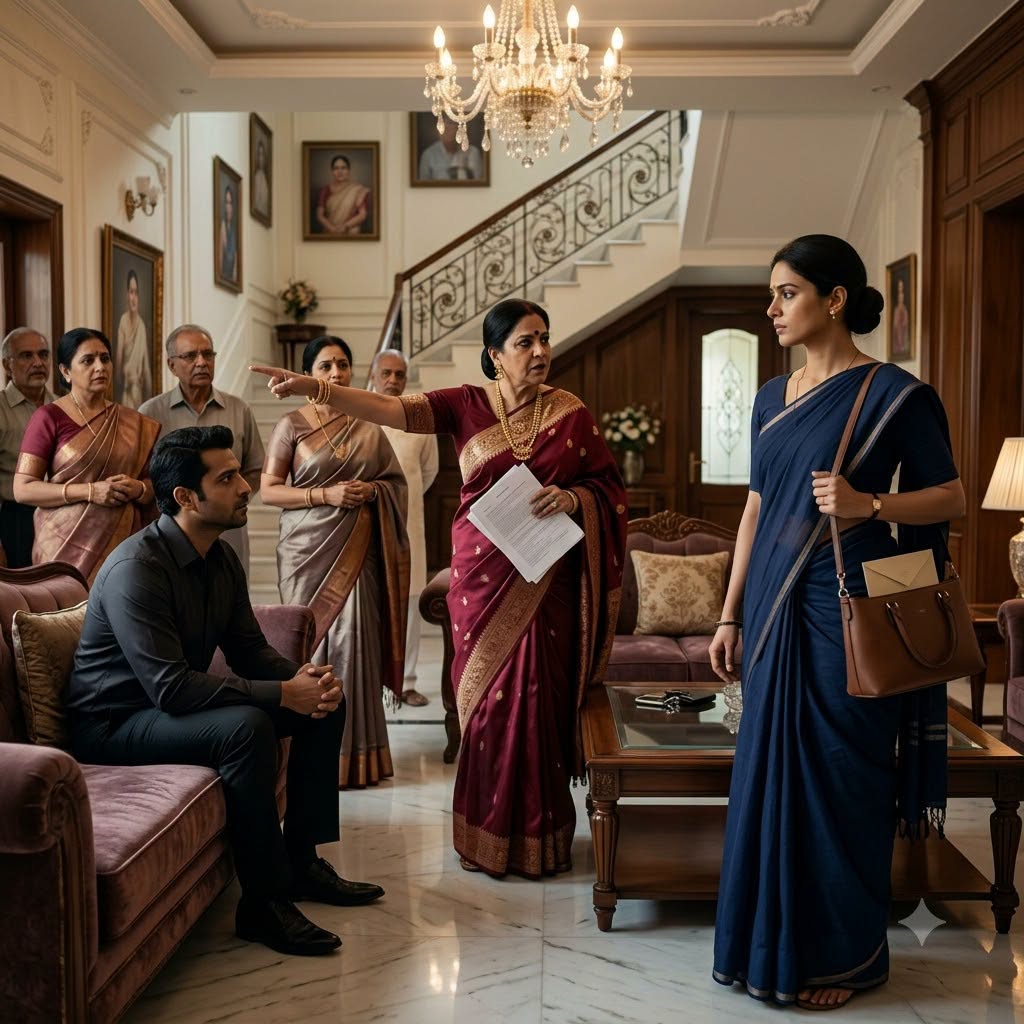
“…Avinash.”
I read the name again.
Then a third time.
“Vaidehi?”
I looked at him.
“Did you take money from my father’s account?”
His expression went blank.
“What?”
“Sixty-two lakh rupees.”
Maaji gripped the back of a chair.
“Don’t listen to that letter,” she whispered.
I held it higher.
“Did you forge my father’s authorization?”
Avinash opened his mouth.
Nothing came out.
And that silence told me more than any confession could have.
Four years earlier, my father had been hospitalized after a stroke. His speech was affected, and he needed assistance with banking matters.
I had given Avinash copies of certain documents because I trusted him to help manage the medical expenses.
I remembered the afternoon clearly.
He had sat beside my father’s hospital bed, holding his hand.
“Don’t worry, Papa,” he said. “I’ll take care of everything.”
My father had smiled at him.
I had smiled too.
Now I felt physically sick.
Advocate Mehta placed the bank statement on the table.
“The transfer was made through an authorization presented as bearing your father’s signature. Nandkumar ji later discovered irregularities in the documents.”
Avinash finally spoke.
“Papa misunderstood.”
The lawyer looked at him.
“Then explain the transfer.”
“It was a loan.”
“From a man recovering from a stroke?”
“He agreed.”
“Where is the loan agreement?”
Avinash looked toward his mother.
She lowered her eyes.
I turned to her.
“You knew?”
Her lips trembled.
“Beta, the house was going to be auctioned.”
I stared at her.
“What auction?”
Maaji began crying.
That was how I learned the second secret.
The house had been mortgaged years earlier to finance Avinash’s failed business venture.
His father had guaranteed the borrowing.
When repayments stopped, the lender initiated recovery proceedings.
The family had concealed everything from me.
Then my father became ill.
And Avinash saw an opportunity.
He arranged for ₹62 lakh to be transferred from my father’s account, presenting it as an authorized loan.
The money helped settle the mortgage and prevent the property from being sold.
My father died eleven months later.
I had spent those months caring for him, believing his savings were safely invested.
After his death, I discovered that his accounts contained far less than I expected.
Avinash told me medical expenses and market losses were responsible.
I believed him.
Again.
I looked at my husband.
“You took money from my dying father to save your family’s house?”
He shook his head.
“I intended to repay it.”
“When?”
“I was trying.”
“Four years, Avinash.”
His face reddened.
“Things were complicated.”
I looked around the room.
At the polished furniture.
The expensive curtains.
The brass lamps Maaji insisted were part of the family’s heritage.
Then I thought of my father.
A retired mathematics teacher who wore the same watch for twenty years because he believed money should be saved for emergencies.
My father, who trusted my husband.
My father, who died without knowing where his savings had gone.
I began crying.
Not loudly.
Just tears falling before I could stop them.
Maaji approached me.
“Vaidehi, listen. We were desperate.”
I stepped away.
“You knew my father was ill.”
“Yes.”
“You knew the money was his.”
She nodded.
“And for four years, you let me cook your meals, wash your clothes, care for your husband, and pay your property taxes while you called this your house.”
She began sobbing.
“I didn’t know what else to do.”
I looked at her.
“You could have told me the truth.”
Nobody answered.
Advocate Mehta waited until the room became quiet.
Then he explained what my father-in-law had done.
Nandkumar ji had discovered the suspicious transfer after reviewing old financial records.
He confronted Avinash.
Avinash claimed the money had been borrowed with permission.
But the documentation troubled him.
He consulted Advocate Mehta and arranged an independent review.
When the evidence suggested that my father’s authorization might not be genuine, Nandkumar insisted the family repay the money.
They couldn’t.
The business was struggling.
The savings were gone.
And the house was their largest remaining asset.
So Nandkumar decided to transfer it to me.
“Why didn’t he tell me?” I whispered.
Advocate Mehta looked down.
“He was ashamed.”
That word hurt.
“He believed he had failed to protect both you and your father.”
I looked at the letter again.
Vaidehi has cared for me with more love than I deserved. I cannot return the years she has given this family. But I can ensure that the money taken from her father does not become an inheritance for the people who benefited from it.
I covered my mouth.
“He was trying to make it right.”
“Yes,” the lawyer said.
“But there is something you should understand.”





