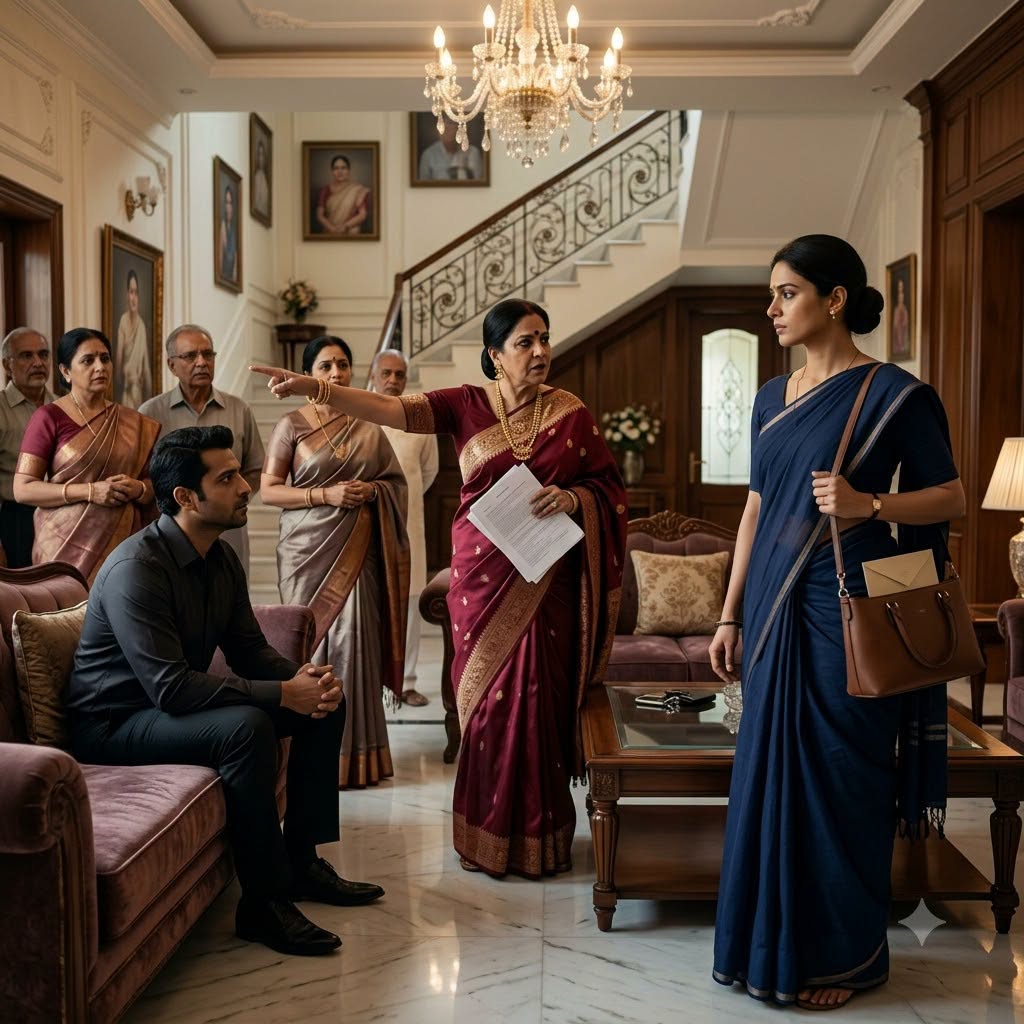
Instead, they made me tired.
She wiped her face.
“I thought if I kept control of the house, nobody could take it away from me.”
I studied her.
“So you tried to take it away from me first?”
She lowered her head.
“Yes.”
That honesty surprised me.
Then she whispered, “I knew what Avinash did. I told myself we would repay the money before anyone discovered it.”
“Did you ever ask him to repay it?”
She shook her head.
“I was afraid.”
I looked toward the window.
Fear.
It had become the family’s excuse for everything.
Fear of losing the house.
Fear of losing reputation.
Fear of telling the truth.
And somehow, every fear had been paid for with my life.
I turned back.
“Maaji, you can remain in the house while we arrange everything properly. But I need you to understand something.”
She nodded.
“I will never again pay for the privilege of being treated like a servant.”
She began crying harder.
I let her cry.
For once, I did not rush to comfort someone at the expense of my own feelings.
Six months later, the investigation reached a turning point.
Avinash’s former business accountant agreed to testify that he had helped prepare the disputed authorization. He produced emails and an old draft bearing a scanned version of my father’s signature.
Avinash had insisted the money was a family loan.
But the records showed that he had described it internally as an emergency transfer to prevent the auction.
There was no repayment schedule.
No correspondence from my father approving the amount.
And no evidence that my father had understood or authorized the transaction.
When Advocate Mehta called with the news, I sat down on the floor of my apartment.
For several seconds, I could not speak.
“Beti?” he asked.
“I’m here.”
“Are you all right?”
I looked at my father’s photograph on the shelf.
“No,” I whispered. “But I think I will be.”
The legal proceedings continued.
Avinash eventually admitted that he had arranged the transfer without obtaining my father’s informed consent. He maintained that he intended to repay the money, but that did not erase what he had done.
The criminal matter proceeded separately from the financial settlement.
I refused to describe his actions as a misunderstanding merely to make the family comfortable.
Through mediation, Avinash agreed to a documented repayment arrangement connected to my father’s estate, while the authorities continued examining the disputed documents.
The house remained registered in my name.
I did not sell it.
Not immediately.
Instead, I asked Advocate Mehta to help me prepare a formal arrangement for Maaji.
She could continue living on the ground floor, with access to the kitchen, courtyard and puja room.
Her medical needs would be provided for.
But she would no longer control the property, demand rent from me, or decide who deserved to enter.
Avinash would have no automatic right to live there.
When Maaji read the agreement, she cried.
“Vaidehi, are you throwing my son out?”
I looked at her.
“I’m giving you something you refused to give me.”
“What?”
“A home without humiliation.”
She covered her face.
For once, I understood that her tears did not require me to surrender anything.
A year after I moved out, I filed for divorce.
Avinash asked me to reconsider.
He came to my apartment carrying flowers.
He said he had changed.
He said he was attending counseling.
He said he had finally understood how badly he had failed me.
I listened.
Then I asked one question.
“If your father had never transferred that house to me, would you have defended me when Ma demanded ₹50,000?”
He looked down.
A long silence passed.
Finally, he whispered, “I don’t know.”
I nodded.
“That’s why I can’t come back.”
He began crying.
I did too.
Because leaving someone you once loved does not mean the love was imaginary.
It means love is no longer enough to make staying safe.
Our divorce was finalized the following year.
I kept my surname.
Not because it belonged to Avinash.
Because I had built a professional life, friendships and an identity under it.
Nobody was going to tell me which name I was allowed to carry.
By then, my consulting work had grown.
I hired two young accountants.
One was a woman returning to work after caring for her mother.
The other had left a marriage in which her husband controlled every rupee she earned.
I recognized something in both of them.
Not weakness.
Exhaustion.
The particular exhaustion of women who have spent years asking permission to exist.
We built a small practice together.
I called it Nayi Disha Financial Services.
New Direction.
Our first major project was helping women organize their savings, understand property documents and regain control of household finances.





