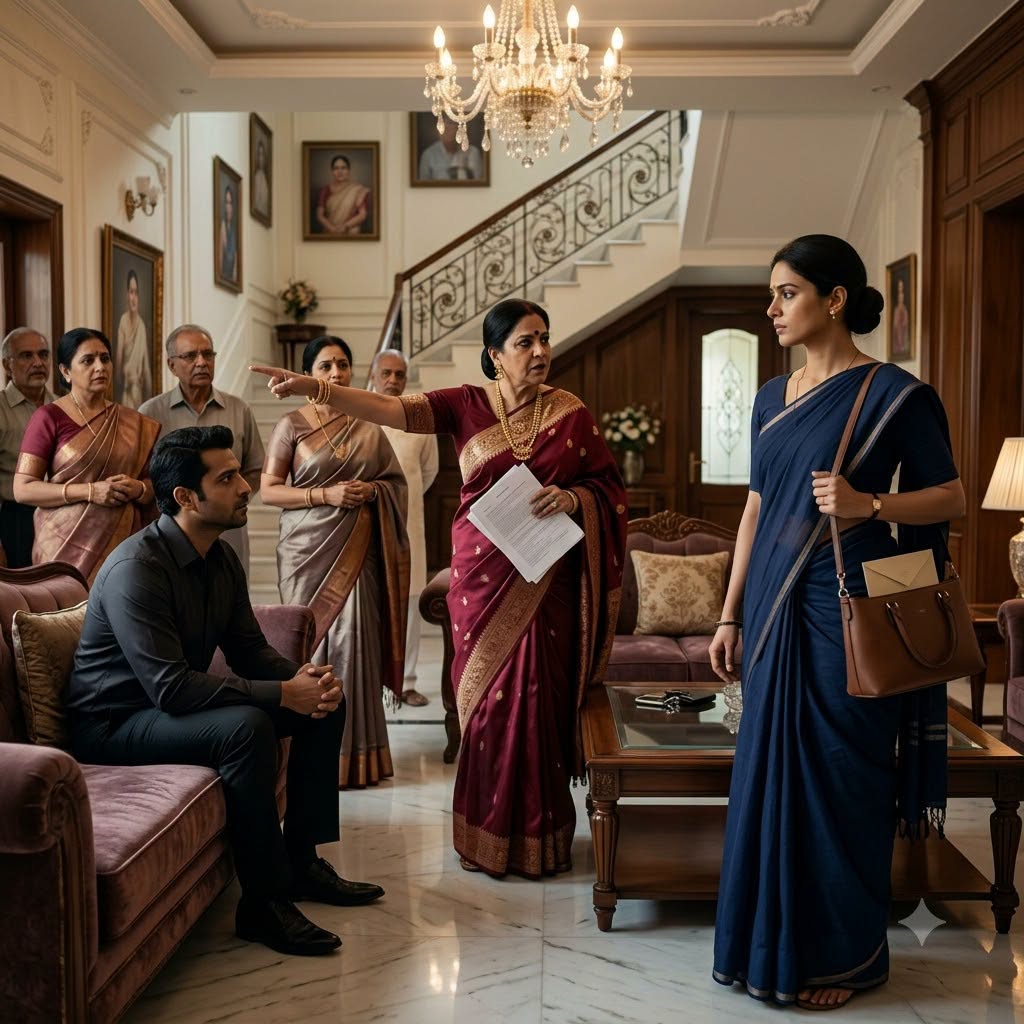
I looked up.
“The registered gift deed transferred the house to you. The financial dispute concerning your father’s account is a separate matter. We will need to examine the bank’s records and your father’s estate documents before deciding what legal action is appropriate.”
I nodded.
For the first time that morning, somebody was explaining my rights instead of telling me my duties.
Then Avinash asked the question I had been waiting for.
“Does this mean Ma has to leave?”
I looked at him.
He sounded frightened.
Not for me.
For his mother.
I almost smiled.
Four years earlier, I had resigned from a career to care for his father.
I had stayed awake through hospital nights.
I had cleaned wounds.
Measured medicines.
Held his father’s hand when he was afraid.
Yet when his mother told me to pay ₹50,000 or leave, Avinash had not asked where I would go.
Now he wanted reassurance.
I placed the letter on the table.
“Maaji can stay for now.”
Relief crossed his face.
Then I continued.
“But you and I are not going to pretend this marriage is fine.”
His relief disappeared.
“Vaidehi…”
“No.”
I raised my hand.
“You watched your mother throw me out of a house that belongs to me. You knew where the money came from. And you let me believe I had no right to stand up for myself.”
He began crying.
“I was afraid you’d leave.”
I looked at the six suitcases beside the staircase.
“You were right.”
That evening, I moved out.
Not because Maaji had ordered me to.
Because I needed to hear my own thoughts somewhere nobody was demanding an explanation.
I rented a small furnished apartment near my former office.
It had one bedroom, a narrow balcony, and a kitchen barely large enough for two people.
I loved it immediately.
The first morning, I made tea for myself.
Only myself.
Nobody complained that it was too strong.
Nobody asked why breakfast was late.
Nobody called from another room demanding hot water.
I sat on the balcony and cried.
Then I opened my laptop.
For four years, I had believed my professional life was over.
But I still had my qualifications.
I still understood accounting.
I still remembered how to work.
I contacted three former colleagues.
One replied within an hour.
Vaidehi! Where have you been? We need someone exactly like you.
Two weeks later, I began consulting part-time for a small manufacturing company.
The first payment was ₹48,000.
I stared at the bank notification for several minutes.
Then I bought myself a blue cotton saree.
I wore it to work the next morning.
Nobody told me it was unnecessary.
Meanwhile, Advocate Mehta obtained additional records.
The bank’s archived documents showed that the disputed authorization had been submitted through an intermediary associated with Avinash.
A handwriting expert later identified significant differences between the disputed signature and my father’s verified signatures.
The findings did not settle every legal question, but they were serious enough for a formal complaint.
Avinash received a notice.
He called me that evening.
“Vaidehi, please withdraw it.”
I sat at my kitchen table.
“Why?”
“Because I could lose everything.”
I looked around my apartment.
The inexpensive curtains.
The secondhand dining table.
The little plant on the windowsill.
“Do you know what I lost?”
He said nothing.
“I lost my career. My independence. Four years of my life. And the last chance to ask my father whether he knew what happened to his money.”
His voice broke.
“I made a mistake.”
“No, Avinash.”
I spoke quietly.
“A mistake is forgetting to pay an electricity bill. You prepared documents, moved money, concealed the transfer, and lied to me for years.”
He began sobbing.
“I didn’t know how to tell you.”
“You knew how to ask me to resign.”
Silence.
“You knew how to let your mother demand rent.”
Silence.
“You knew how to remain quiet when she told me to leave.”
I closed my eyes.
“You were only unable to tell the truth when it would cost you something.”
Then I ended the call.
Three months later, Maaji came to my apartment.
She arrived alone.
No driver.
No jewellery except her mangalsutra.
She stood at the doorway holding a steel container.
“I made your favourite poha.”
I looked at her.
For four years, she had never asked what I liked for breakfast.
I let her inside.
She sat on the edge of my sofa.
The apartment was quiet.
Finally, she said, “The house feels empty.”
I waited.
“Avinash is hardly there.”
I said nothing.
“Your room is closed.”
I looked at her.
“It’s not my room anymore, Maaji. I don’t live there.”
She began crying.
“I was wrong.”
I had imagined those words many times.
I thought they would make me feel victorious.





