“…doesn’t need to raise her voice to show disrespect,” Devyani finished. “Sometimes a woman’s attitude is enough.”
I looked at my wife.
“Then perhaps we should examine our own attitudes before judging hers.”
She stiffened.
“Harivansh, don’t lecture me in front of our son.”
I picked up my car keys.
“I’m not lecturing anyone. I’m going to find out why my daughter-in-law looks as though she hasn’t slept in a month.”
Avinash rolled his eyes.
“Bauji, you’re making a mountain out of nothing.”
I looked at him.
“Then you have nothing to fear from the truth.”
What neither of them knew was that I had already visited Avinash’s apartment that morning.
And what I had found there was sitting inside the brown envelope beneath my newspaper.
At seven that morning, Charulata had called me.
Her voice was barely audible.
“Bauji, could you please come for ten minutes?”
I immediately sat up.
“What happened, beta?”
“Nothing serious. I just need someone to stay with the children.”
“Where is Avinash?”
“He went out.”
“And you?”
There was a long silence.
Then she whispered, “I need to see a doctor.”
I was at her apartment twenty minutes later.
The front door was unlocked.
Inside, the kitchen looked as though someone had been working there all night.
Three lunchboxes stood on the counter.
School uniforms hung beside the refrigerator.
A pressure cooker was cooling on the stove.
And on the dining table lay a notebook.
I opened it because my name was written on the first page.
Bauji’s medicines — remind him after breakfast.
Below it were dozens of other reminders.
Children’s school fees.
Devyani Ma’s physiotherapy.
Avinash’s dry cleaning.
Electricity bill.
Groceries.
Parent-teacher meeting.
Every person’s needs had been recorded.
Except Charulata’s.
Then I noticed a small plastic bag beneath the notebook.
Inside were medical reports.
And a prescription dated six weeks earlier.
The diagnosis was not something I fully understood, but two words stood out.
Severe anaemia.
Her haemoglobin level was dangerously low.
There was also a referral for further evaluation of prolonged bleeding.
I felt my chest tighten.
At that moment, Charulata emerged from the bedroom.
She was holding the wall for support.
“Bauji?”
I hurried toward her.
“Beta, sit down.”
She tried to smile.
“I’m sorry. I haven’t cleaned the living room.”
I stared at her.
Even while struggling to stand, she was apologizing for the furniture.
I drove her to the hospital.
The doctor examined her and ordered further tests.
She explained that Charulata’s symptoms required treatment and investigation, and that the severity of her anaemia could explain much of her exhaustion and dizziness.
Then she asked a question.
“Mrs. Kulkarni, have you been taking the prescribed medicines?”
Charulata lowered her eyes.
“Not regularly.”
“Why?”
She hesitated.
I watched her fingers twist together.
Finally, she whispered, “They upset my stomach, and sometimes I forget after preparing everyone’s meals.”
The doctor looked concerned.
“Are you eating regularly?”
Charulata said nothing.
I felt ashamed.
The doctor spoke gently.
“You need proper follow-up, adequate nutrition, and a treatment plan you can manage. We also need to understand the cause of the bleeding.”
Charulata nodded.
Then she asked, “Can I go home before lunch? My children will be hungry.”
I turned away.
Because I was crying.
After the appointment, Charulata asked me not to tell Avinash.
“Bauji, please. He’ll be angry that I didn’t tell him sooner.”
I looked at her.
“Why would he be angry that you’re ill?”
She smiled sadly.
“He says I always have an excuse.”
I wanted to tell her that my son would understand.
But I could no longer make promises on his behalf.
Instead, I said, “You deserve care, beta.”
Her eyes filled.
Then she whispered something I would never forget.
“Sometimes I feel as though everyone would be happier if I simply disappeared for a few days.”
My heart nearly stopped.
I pulled my chair closer.
“Charulata, when you say that, do you mean you want to hurt yourself?”
She shook her head quickly.
“No, Bauji. I just want to sleep somewhere nobody needs me.”
I held her hand.
“Then we will make sure you get rest. And if those feelings become darker, you tell me or your doctor immediately. You mustn’t carry them alone.”
She began crying.
For several minutes, I simply sat beside her.
I had spent my entire career solving other people’s financial problems.
Yet I had failed to notice the suffering inside my own family.
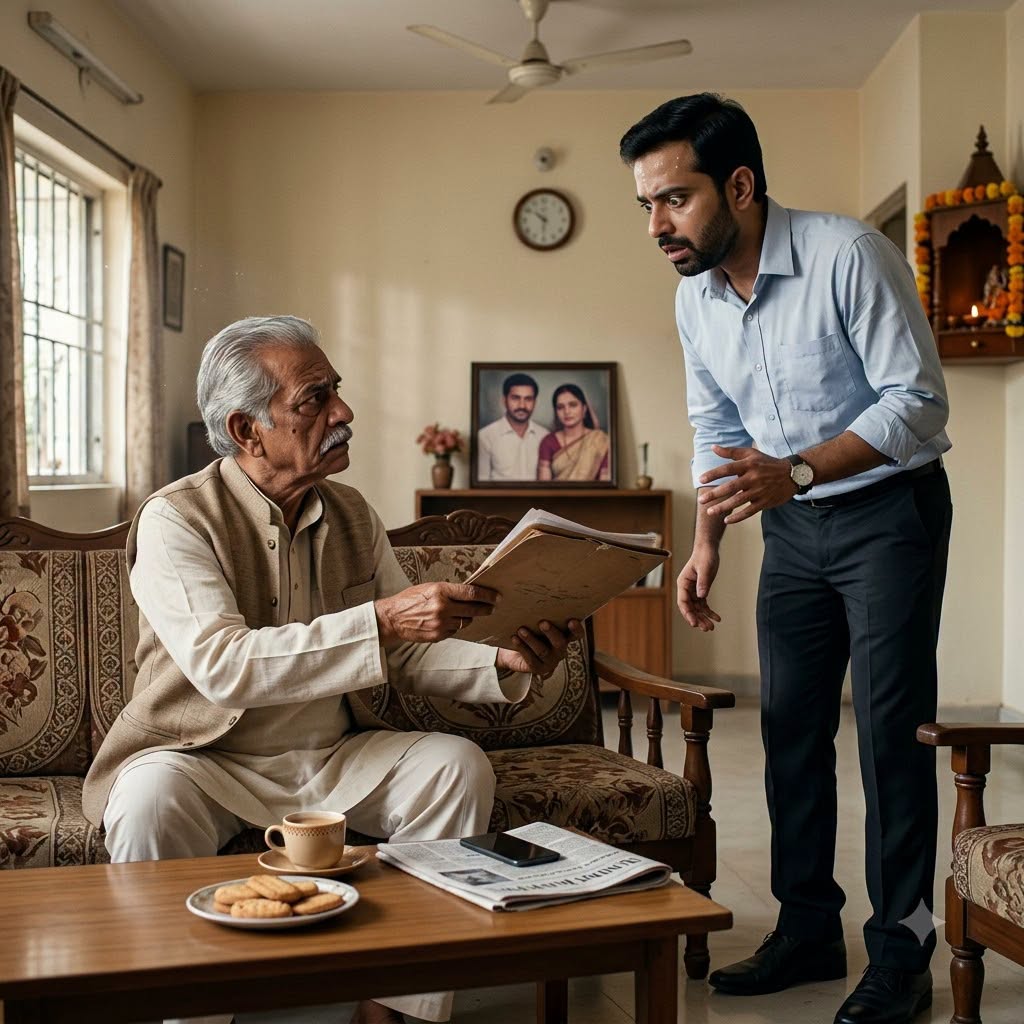
Now, sitting across from Avinash and Devyani, I opened the brown envelope.
My son frowned.
“What’s that?”
I placed the hospital discharge summary on the table.
“Your wife’s medical report.”
He stared at it.
“Why do you have that?”
“Because I took her to the hospital this morning.”
His expression changed.
“Hospital?”
“Yes.”
Devyani leaned forward.





