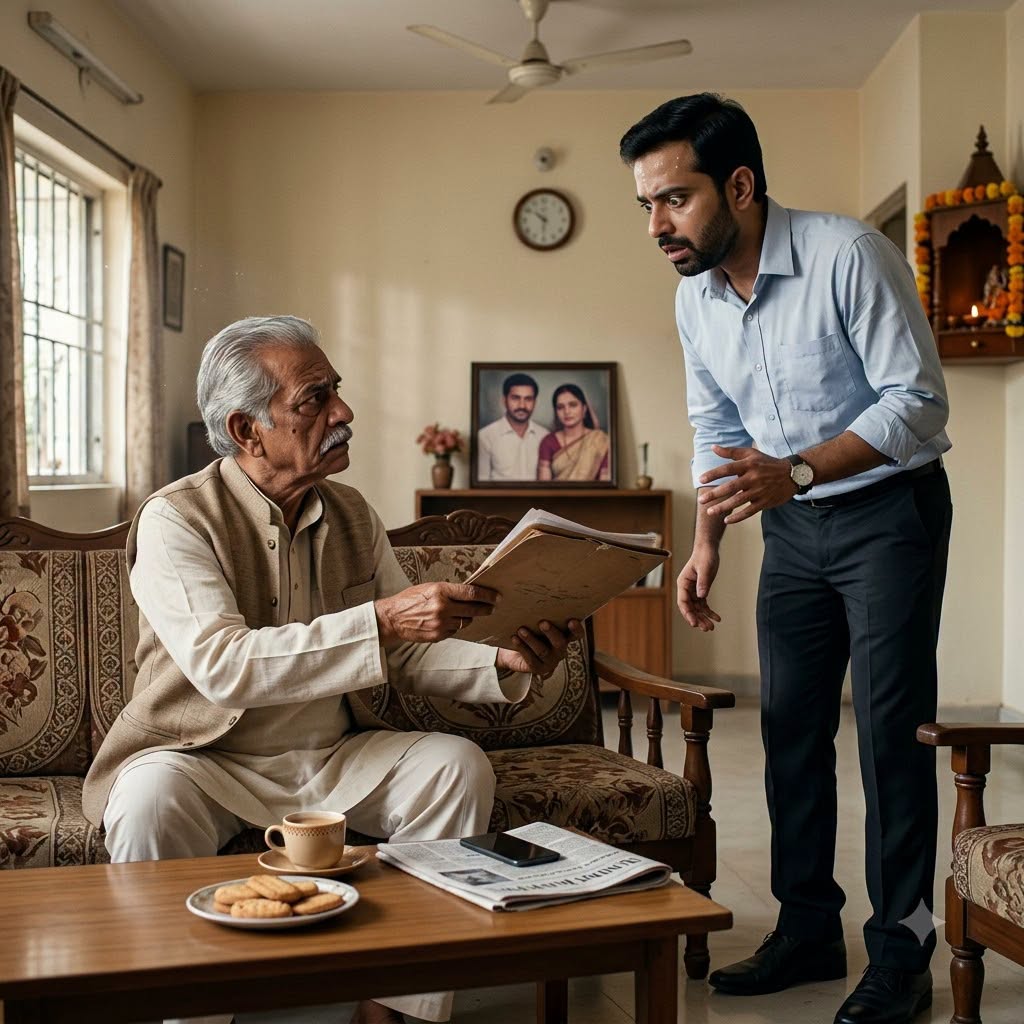
Then whispered, “I understand.”
That night, after everyone left, I sat on my balcony with a cup of chai.
Devyani joined me.
For a long time, we watched the city lights.
Then she whispered, “Harivansh, do you think we failed as parents?”
I looked at her.
“We taught our son that earning money made him more important than the people who cared for him.”
She began crying.
I continued.
“And we taught our daughter-in-law that peace required silence.”
Devyani wiped her eyes.
“So what do we do now?”
I looked toward the dark sky.
“We teach the grandchildren something different.”
A year after Avinash first announced he wanted a divorce, Charulata made her decision.
She chose to continue the marriage.
But not under the old conditions.
She returned to teaching part-time.
Avinash took permanent responsibility for school drop-offs and several household tasks.
They continued counseling.
And they agreed that no relative, including us, would interfere in their marriage without being invited.
I was relieved.
But I also understood that Charulata would have been justified in choosing differently.
Her decision belonged to her.
One Sunday morning, I visited their apartment.
The kitchen smelled of fresh poha.
Avinash was standing at the stove.
Pradyumna was setting plates.
Ishwari was arranging spoons.
And Charulata sat at the dining table reading a book.
I stopped in the doorway.
For a moment, I could hardly believe what I was seeing.
Avinash looked up.
“Bauji! Tea?”
I smiled.
“Yes.”
He poured me a cup.
Then placed a plate of hot poha before Charulata.
She looked up.
“Thank you.”
He smiled.
“You’re welcome.”
It was such a small exchange.
But it carried the weight of everything that had changed.
I sat down.
And for the first time, I watched my daughter-in-law eat breakfast while it was still hot.
I had once believed that a good father was a man who provided a house, education, and financial security.
Now, at sixty-nine, I understood that fatherhood required something more difficult.
The courage to recognize when your own child was wrong.
The humility to admit when you had taught him badly.
And the willingness to protect someone vulnerable, even when doing so made your family uncomfortable.
My son had come to me demanding a divorce because his wife was lazy.
Instead, he discovered that the woman he called lazy had been carrying an entire household while her own health deteriorated.
And I discovered something equally painful.
For years, I had watched injustice happen inside my family and mistaken my silence for peace.
I would not make that mistake again.
Because a family is not strong when one person quietly suffers to keep everyone else comfortable.
A family becomes strong when everyone learns to carry their share.
And sometimes, the most important question a father can ask his son is not whether his wife cooks well, keeps the house clean, or obeys his mother.
Sometimes, it is simply this:
“When was the last time you noticed she was tired?”
If you were Charulata, would you have forgiven Avinash after years of neglect, or would you have chosen a new life without him? And do you think Harivansh was right to confront his own son instead of defending him? Share your feelings in the comments, and follow the page for more emotional stories about family, marriage, hidden suffering, and the courage to change before it’s too late.





